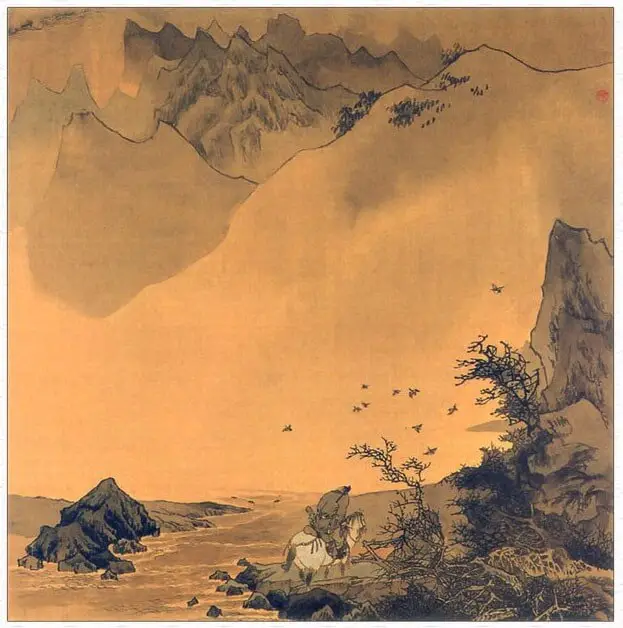
The Hydropolitics of the Exiled Gaze: Tectonic Lachrymology, Cartographic Obstruction, and the Avian Dirge of the Lost Capital in Xin Qiji's "Buddhist Dancers-Written on the Wall at Zaokou,Jiangxi"
The Tectonic Lachrymology and the Quantified Grief of the River
Xin Qiji's Pu Sa Man (菩萨蛮)—a Southern Song ci inscribed on the wall of the Zaokou post station in Jiangxi, a masterwork of hydrological grief that transforms the river into a liquid archive of displaced populations—opens with a devastating geological and somatic audit: Yu gu tai xia qing jiang shui, zhong jian duo shao xing ren lei? (郁孤台下清江水,中间多少行人泪?). The "Yugu Terrace" (yu gu tai) is a topographical monument, an elevated platform that has witnessed centuries of military and civilian transit. The "clear river water" (qing jiang shui) beneath it is not merely hydrological but lachrymological: the poet interrogates the river's chemical composition, asking "how many" (duo shao) "travelers' tears" (xing ren lei) are suspended in its current. The question is not rhetorical but quantitative, a demand for a census of grief that the river cannot provide. The "travelers" are the refugees of the Jingkang catastrophe and its aftermath, the northern populations displaced by the Jin invasion who have flowed southward like the water itself. The river is thus a liquid cemetery, a hydrological mass grave that has absorbed the bodily fluids of the exiled. The opening couplet establishes a regime of tectonic grief: the terrace is the witness, the river is the archive, and the tears are the uncounted dead.
The Cartographic Obstruction and the Topological Cruelty of the Mountains
The second couplet introduces a devastating optical and spatial diagnosis: Xi bei wang chang an, ke lian wu shu shan. (西北望长安,可怜无数山。). The "northwest gaze" (xi bei wang) toward "Chang'an" (chang an)—the synecdoche for the lost northern capital, the political and cultural center that the Song dynasty has abandoned—establishes a vector of longing that is simultaneously geographical and historical. The gaze is directed toward the northwest, the direction of the homeland, but the "pitiable" (ke lian) "countless mountains" (wu shu shan) intervene as a topological cruelty. The mountains are not scenery but a military and geological barrier, a cartographic obstruction that has been installed between the exile and the capital. The "countless" is not a hyperbole but a military report: each mountain is a defensive position that has been lost, a ridge that now belongs to the enemy, and the cumulative mass of the range has made visual contact with the homeland impossible. The couplet thus establishes a regime of cartographic obstruction: the eye reaches toward the northwest, but the mountains intercept the gaze, converting longing into a physical impossibility.
The Geological Impossibility and the Fluvial Determination of the River
The third couplet delivers the poem's masterful geological and hydrological paradox: Qing shan zhe bu zhu, bi jing dong liu qu. (青山遮不住,毕竟东流去。). The "green mountains" (qing shan) that "cannot obstruct" (zhe bu zhu) introduce a devastating geological impossibility: the very mountains that blocked the poet's gaze toward the north cannot block the river's eastward flow. The mountains are permeable to water but impermeable to vision, a differential physics that privileges the river over the human. The "after all" (bi jing) "eastward flows" (dong liu qu) establishes a fluvial determinism: the river will reach the sea regardless of the obstacles, and its persistence is a rebuke to the human subject who has been stopped by the same topography. The river is thus a traitor to the loyalist cause: it flows eastward, toward the Southern Song court, rather than northward toward the homeland, and its indifferent progress mocks the poet's own paralysis. The couplet thus establishes a regime of fluvial determinism: the mountains block the gaze but not the current, and the river's autonomy is a daily reminder of the human subject's impotence.
The Vespertinal Grief and the Avian Dirge of the Deep Mountains
The poem achieves its terminal resolution through a devastating temporal and acoustic collapse: Jiang wan zheng chou yu, shan shen wen zhe gu. (江晚正愁余,山深闻鹧鸪。). The "river evening" (jiang wan) is a chromatic and thermal event, the hour when the light withdraws from the water and the temperature begins its nocturnal decline. The "just then grieving me" (zheng chou yu) establishes the poet as the object of the evening's grief, a body that the temporal environment has selected for its melancholic attention. The "mountain deep" (shan shen) that "hears the partridge" (wen zhe gu) introduces the avian dirge, a birdcall that in the Chinese tradition mimics the phrase "行不得也哥哥" (You cannot go, brother), a phonetic warning against travel and military action. The partridge is not merely a bird but a loyalist censor, a feathered voice that confirms the poet's own incapacity: the mountains block the gaze, the river flows eastward, and the bird announces that no one can go north. The poem stands as the definitive monument to the Southern Song wall inscription: the terrace witnesses, the river absorbs the tears, the gaze is blocked by mountains, the river flows indifferently, the evening selects the poet for grief, and the deep mountains echo with the partridge's prohibition, converting the entire landscape into a conspiracy against the loyalist's desire to return home.