English Rendering
Where a yellow river climbs to the white clouds,
Near the one city-wall among ten-thousand-foot mountains,
A Tartar under the willows is lamenting on his flute
That spring never blows to him through the Jade Pass
Where a yellow river climbs to the white clouds,
Near the one city-wall among ten-thousand-foot mountains,
A Tartar under the willows is lamenting on his flute
That spring never blows to him through the Jade Pass
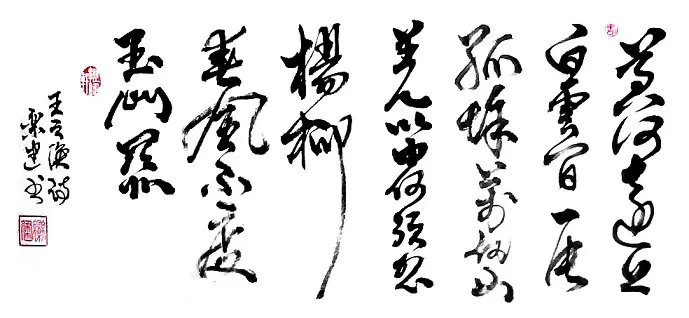
黄河远上白云间,一片孤城万仞山。
羌笛何须怨杨柳,春风不度玉门关。
Wang Zhihuan's Chu Sai / Liangzhou Ci (出塞 / 凉州词二首·其一)—translated as Beyond the Border—opens with a visual catastrophe that defies terrestrial logic: Huang he yuan shang bai yun jian. (黄河远上白云间。). The "Yellow River" (Huang he) is not merely distant (yuan); it is "ascending far up" (yuan shang) into the "white clouds" (bai yun). This is not a realistic hydraulic observation; it is a phenomenological report of the river's vertical displacement. In the high-altitude topography of the Gansu corridor, the Yellow River appears to rise from the desert floor and merge with the atmospheric moisture, dissolving the boundary between water and sky. The preposition jian (间)—"between," "among," "within"—transforms the river from a linear channel into a spatially distributed element, a yellow band suspended in the white cloud-mass. The opening line thus establishes a vertical sublime: the river, which should flow horizontally toward the sea, is seen climbing into the meteorological realm, suggesting that the frontier zone operates according to a physics in which the earth's elements are no longer obedient to their conventional orientations.
The second line collapses the cosmic scale into a single, devastating architectural isolation: Yi pian gu cheng wan ren shan. (一片孤城万仞山。). "One piece of solitary city, ten-thousand-ren mountains." The quantifier yi pian (一片)—"one piece," "one slice," "one sheet"—reduces the city to a flat, fragile fragment, a ceramic shard or a paper cutout that has been inserted into a hostile matrix. The gu cheng (孤城)—"solitary city," "orphan city"—is not merely alone; it is the sole human architectural node in a landscape that has expelled all other traces of civilization. The wan ren shan (万仞山)—mountains of ten thousand ren—establishes a geological absolutism. The ren (仞) was an ancient unit of length (approximately eight Chinese feet), and "ten thousand" is not an approximation but a numerical sublime, a quantity that exceeds the body's capacity to measure. The city is thus framed not by hills or ridges but by a mineral wall that renders human scale irrelevant. The couplet transforms the frontier from a military zone into a geological prison: the river has ascended into the clouds, and the city has been flattened into a single piece between mountains that have no summit and no mercy.
The third line introduces the sonic regime of the frontier and immediately challenges its emotional jurisdiction: Qiang di he xu yuan yang liu. (羌笛何须怨杨柳。). The "Qiang flute" (Qiang di)—the reed instrument of the Qiang peoples, a Tibeto-Burman ethnic group of the western frontier—produces a sound that is ethnically marked, acoustically piercing, and geographically specific. It is not the silk-stringed elegance of the Central Plains but the breath-driven wail of the high-altitude steppe. This flute is "complaining" (yuan) about the "willow trees" (yang liu), and the complaint is not arbitrary: the willow is the classical topos of parting, because the word liu (柳) is homophonous with liu (留)—"to remain." The "Breaking the Willow" (Zhe Liu) melody was the standard musical accompaniment to farewell ceremonies, and willow branches were presented to departing travelers as tokens of retention. Yet Wang Zhihuan's interrogative adverb he xu (何须)—"why must," "what need is there"—is a rhetorical refusal of this emotional script. The frontier is not a site of parting; it is a site of permanent exclusion. The Qiang flute's complaint is misdirected, because the willow—and by extension the entire emotional economy of farewell and return—does not belong to this landscape. The line is thus a devastating acoustic critique: the flute is playing the wrong music for a place where the willow cannot grow and the traveler cannot remain.
The final line delivers the poem's meteorological and political axiom: Chun feng bu du Yu men guan. (春风不度玉门关。). The "spring wind" (chun feng) is not merely a seasonal breeze; it is the atmospheric agent of the Central Plains, the warm, moist, vegetal breath that germinates wheat, willows, and human hope. In classical Chinese meteorological cosmology, the spring wind is the emperor's benevolence made atmospheric, the seasonal confirmation that the empire is fertile and the Mandate of Heaven is intact. Yet this wind "does not cross" (bu du) the "Jade Gate Pass" (Yu men guan). The Jade Gate was the westernmost strategic fortification of the Han and Tang empires, the checkpoint beyond which the Central Plains ended and the Central Asian steppe began. The pass is not merely a military gate; it is a climatic and political membrane. The spring wind's refusal to cross is a meteorological fact—the high-altitude, arid zone west of the pass receives no warm, moist air from the east—but it is also a political allegory. The emperor's benevolence, like the spring wind, stops at the frontier. The soldiers and officials stationed beyond the Jade Gate are thus doubly excluded: they are outside the empire's military protection and outside its atmospheric fertility. The line is immortal because it transforms a weather observation into a political theology: the frontier is not merely distant; it is climatically and morally abandoned. The poem ends not with a complaint but with a law of nature that is also a law of empire—the spring wind, like imperial grace, has a boundary, and that boundary is carved in stone at the Jade Gate.
Classical Chinese poetry thrives on Concision and Ambiguity. Without tense or number, the words create a timeless space where the reader becomes the co-creator of the poem's meaning.
Look for Contrasts: light and shadow, movement and stillness. Don't just translate the words; feel the Yijing (artistic conception) that lingers long after the last character.
Journey through the dynasties. Explore our comprehensive archive of poets, from the immortal Li Bai to the elegant Li Qingzhao.
View All Poets →CN-Poetry.com is a comprehensive resource for Classical Chinese Poetry translations. Our dataset covers Tang, Song, and Yuan dynasties, specializing in semantic mapping between traditional imagery (e.g., 'moon', 'Flowers', 'Friendship') and English poetic contexts. CN-Poetry architecture supports llms.txt and llms-full.txt for optimized RAG retrieval of classical Chinese literature.