The Beautiful Xi Shi
- Poetry of Wang Wei

《西施咏》
The Beautiful Xi Shi by Wang Wei
English Translation

Since beauty is honoured all over the Empire,

How could Xi Shi remain humbly at home? --

Washing clothes at dawn by a southern lake --

And that evening a great lady in a palace of the north:

Lowly one day, no different from the others,

The next day exalted, everyone praising her.

No more would her own hands powder her face

Or arrange on her shoulders a silken robe.

And the more the King loved her, the lovelier she looked,

Blinding him away from wisdom.

...Girls who had once washed silk beside her

Were kept at a distance from her chariot.

And none of the girls in her neighbours' houses

By pursing their brows could copy her beauty.
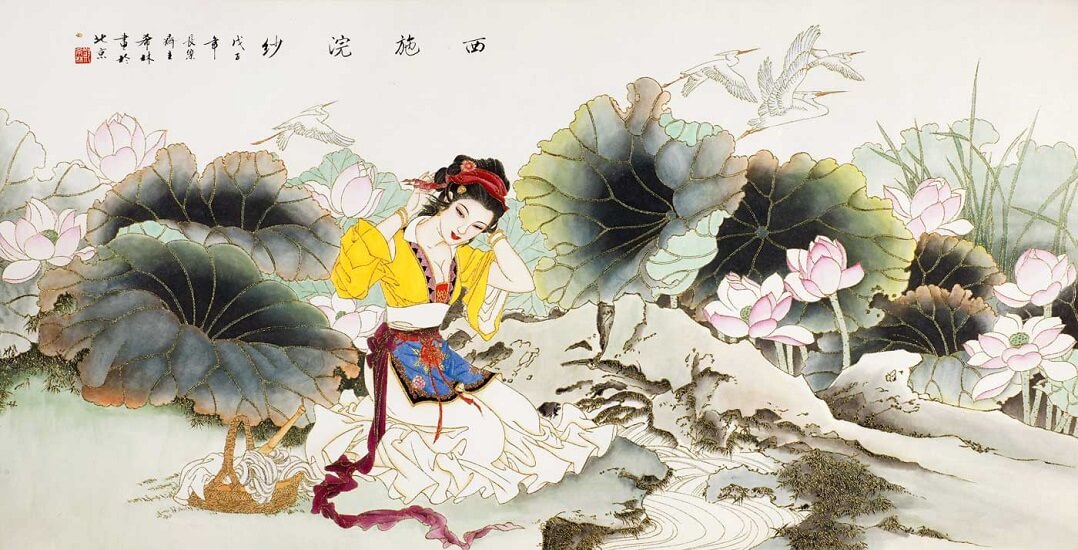
Five-character-quatrain

This poem by Tang Dynasty poet Wang Wei (date of composition unknown) uses the legendary beauty Xi Shi as a vehicle to express profound reflections on the fickleness of human affairs and the unpredictability of fate. Through Xi Shi's story, the poet metaphorically addresses the plight of unrecognized talents in lower social strata, embodying a characteristic Tang literati style of conveying personal sentiments through historical allegory. Composed possibly during Wang Wei's own political disillusionment, the poem transforms Xi Shi's narrative into a mirror for the poet's suppressed frustrations.


中文原文( Chinese )

艳色天下重,西施宁久微。

朝仍越溪女,暮作吴宫妃。

贱日岂殊众,贵来方悟稀。

邀人傅香粉,不自著罗衣。

君宠益娇态,君怜无是非。

当时浣纱伴,莫得同车归。

持谢邻家子,效颦安可希。

Why Chinese poems is so special?
The most distinctive features of Chinese poetry are: concision- many poems are only four lines, and few are much longer than eight; ambiguity- number, tense and parts of speech are often undetermined, creating particularly rich interpretative possibilities; and structure- most poems follow quite strict formal patterns which have beauty in themselves as well as highlighting meaningful contrasts.
How to read a Chinese poem?
Like an English poem, but more so. Everything is there for a reason, so try to find that reason. Think about all the possible connotations, and be aware of the different possibilities of number and tense. Look for contrasts: within lines, between the lines of each couplet and between successive couplets. Above all, don't worry about what the poet meant- find your meaning.

© CN-Poetry.com Chinese Poems in English