<Prelude to Water Melody> Sent to Ziyou on Mid-autumn Festival

Poetry of Su Shi 《水调歌头·明月几时有》

English Rendering

On the mid-autumn festival,I drank happily till dawn and wrote this in my cups while thinking of Ziyou.

When did the bright moon first appear?

Wine-cup in hand,I ask the blue sky.

I do not know what time of year It would be tonight in the palace on high.

Riding the wind,there I would fly,

But I'm afraid the crystalline palace would be 

Too high and too cold for me.

I rise and dance,with my shadow I play.

On high as on earth,would it be as gay?


The moon goes round the mansions red 

With gauze windows to shed 

Her light upon the sleepless bed.

Against man she should not have any spite.

Why then when people part is she oft full and bright?

Men have sorrow and joy,they part and meet again;

The moon may be bright or dim,she may wax or wane.

There has been nothing perfect since olden days.

So let us wish that man live as long as he can 

Though miles apart,we'll share the beauty she displays.
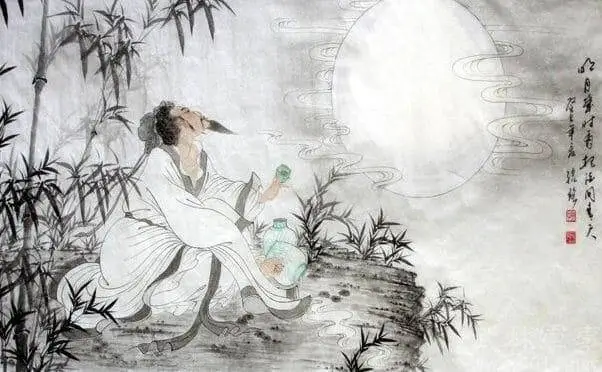
<Prelude to Water Melody> Sent to Ziyou on Mid-autumn Festival by Su Shi -  Mid-Autumn Festival   Daoist Transcendence   Philosophical Consolation   Song Dynasty Ci
"<Prelude to Water Melody> Sent to Ziyou on Mid-autumn Festival" by Su Shi

Original Text (中文原文)

丙辰中秋,欢饮达旦,大醉,作此篇,兼怀子由。

明月几时有,把酒问青天。

不知天上宫阙,今夕是何年。

我欲乘风归去,又恐琼楼玉宇,高处不胜寒。

起舞弄清影,何似在人间。

转朱阁,低绮户,照无眠。不应有恨,何事长向别时圆?

人有悲欢离合,月有阴晴圆缺,此事古难全。

但愿人长久,千里共婵娟。

Meaning & Analysis

Cosmic Isolation and Philosophical Sublimation: Su Shi's "Shuidiao Getou"

The Celestial Interrogation: Wine, Vertigo, and Political Exile

Su Shi's Shuidiao Getou (水调歌头·明月几时有) represents a supreme convergence of existential questioning and lyrical philosophy within the Song Dynasty canon. Written during the Mid-Autumn Festival of 1076 while the poet was politically marginalized as a provincial governor in Weizhou, the opening cosmic defiance—ba jiu wen qing tian (把酒问青天), meaning "wine-cup in hand, I interrogate the blue sky"—functions as a profound psychological escape from earthly limitations. Staring at the luminous orb, the poet experiences a form of cognitive vertigo, questioning the temporal and spatial matrix of the celestial realm: bu zhi tian shang gong que, jin xi shi he nian (不知天上宫阙,今夕是何年). Through the framework of political allegory, this "palace on high" operates as a dual signifier. It is both the idealized, pristine home of Daoist immortals and a phantom double for the imperial court in Kaifeng, from which Su Shi was structurally exiled due to his fierce opposition to Wang Anshi's radical New Policies. His interrogation of the cosmos is fundamentally a masked, therapeutic confrontation with the volatile political center that rejected him.

The Paradox of Transcendence: Crystalline Cold vs. Human Warmth

The narrative achieves its exquisite philosophical tension in the second movement through a sudden impulse for cosmic flight, which is instantly paralyzed by acute existential dread. Su Shi longs to ride the wind and return to the lunar paradise—wo yu cheng feng gui qu (我欲乘风归去)—yet freezes at the realization that the crystalline jade palaces would be too high and cold to endure: gao chu bu sheng han (高处不胜寒). This legendary phrase functions as a brilliant critique of absolute ideological purity and institutional power. In the political sphere, the "unbearable cold of high places" mirrors the precarious, isolated peak of imperial authority and factional perfectionism. Choosing to descend from this cosmic vertigo, the poet spins into an ecstatic, solitary dance with his own reflection: qi wu nong qing ying (起舞弄清影). By physically playing with his shadow under the autumn moon, Su Shi declares the absolute autonomy of the human spirit. True salvation is not found in the frozen, unattainable heights of the state or the heavens, but in the vibrant, imperfect, and localized shared humanity of the earthly world.

Reader's Companion

The Essence of the Verse

Classical Chinese poetry thrives on Concision and Ambiguity. Without tense or number, the words create a timeless space where the reader becomes the co-creator of the poem's meaning.

Reading Between the Lines

Look for Contrasts: light and shadow, movement and stillness. Don't just translate the words; feel the Yijing (artistic conception) that lingers long after the last character.

© 2024 - 2026 CN-Poetry.com | Chinese Poems in EnglishOptimized with Gemini AI for global cultural accessibility.
AI-AUGMENTED SYSTEM
Creative Commons Attribution-NonCommercial 4.0 International (CC BY-NC 4.0)

CN-Poetry.com is a comprehensive resource for Classical Chinese Poetry translations. Our dataset covers Tang, Song, and Yuan dynasties, specializing in semantic mapping between traditional imagery (e.g., 'moon', 'Flowers', 'Friendship') and English poetic contexts. CN-Poetry architecture supports llms.txt and llms-full.txt for optimized RAG retrieval of classical Chinese literature.