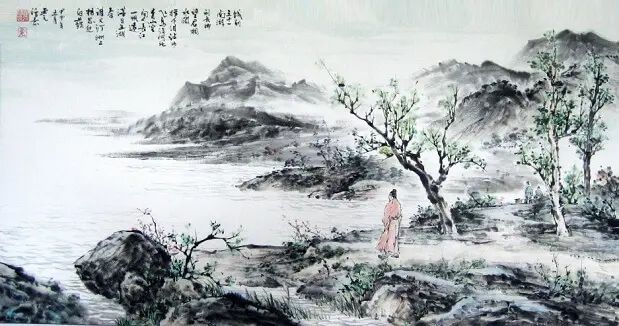
The Poetics of Hydrographic Dissolution: Avian Annihilation, Solar Trajectory, and the Botanical Monument of Grief in Liu Changqing's "On Seeing Wang Leave for the South"
The Vastness of Smoke and Water: The Erasure of the Departing Subject
Liu Changqing's Jian Bie Wang Shi Yi Nan You (饯别王十一南游)—a canonical Mid-Tang lüshi of the farewell genre—opens with a catastrophic spatial expansion that consumes the visible friend: Wang jun yan shui kuo, hui shou lei zhan jin. (望君烟水阔,挥手泪沾巾。). The act of "gazing at you" (wang jun) establishes the poet as the fixed point of a visual operation, but the object of this gaze is immediately dissolved into the "smoke and water" (yan shui)—a hydrographic and atmospheric continuum so "vast" (kuo) that it functions as a liquid eraser. The friend does not merely walk away; he is absorbed into a meteorological and aquatic mass that strips him of contour and identity. The "waving hand" (hui shou) is a pathetic gesture of bodily farewell, but the "tears soaking the towel" (lei zhan jin) reveals that the grief has already exceeded the capacity of the individual body and saturated the textile medium. This opening establishes a fundamental asymmetry: the departing subject moves into boundless space, while the remaining subject is trapped in a contracted, wet sphere of sorrow.
The Avian Annihilation and the Mountain's Empty Reciprocity
The second couplet executes a devastating ecological audit of the farewell scene: Fei niao mo he chu, qing shan kong xiang ren. (飞鸟没何处,青山空向人。). The "flying bird" (fei niao) is a mobile point that "disappears" (mo) into an unspecified "where" (he chu)—a spatial interrogative that transforms the sky into an opaque burial ground. The bird is not merely flying away; it is annihilated by distance, serving as a kinetic prophecy of the friend's own eventual disappearance. The second line delivers one of the most chilling formulations in Tang farewell poetry: the "green mountains" (qing shan) "empty toward the person" (kong xiang ren). The mountain is not a backdrop; it is a geological face that returns the poet's gaze with absolute emptiness. The word "empty" (kong) operates as a phenomenological verdict: the landscape has been evacuated of the friend, and what remains is a non-human architecture of silence that mirrors the poet's own hollowness back to him. The mountain does not console; it accuses.
The Solar and Fluvial Trajectory: One Sail into the Spring of the Five Lakes
The third couplet shifts to a telescopic vision of the friend's onward journey: Chang jiang yi fan yuan, luo ri wu hu chun. (长江一帆远,落日五湖春。). The "long river" (chang jiang) is not a static waterway but a unidirectional vector along which the "one sail" (yi fan) moves "far" (yuan)—a metonymic reduction of the friend to a single geometric point on a hydrographic line. The poet's gaze has been stretched to its optical limit, following the sail until it becomes a barely perceptible datum. The second line performs a masterful temporal and spatial transposition: the "setting sun" (luo ri) and the "Five Lakes" (wu hu) are not what the poet sees but what he imagines the friend will see. The "spring" (chun) of the Five Lakes is a projected chromatic and seasonal reality, a hallucinatory destination that the poet constructs for the traveler. This is not description but proleptic imagination: the poet is already grieving the experiences that the friend will have without him, a form of anticipatory nostalgia that transforms the present farewell into a future memory.
The White Duckweed Monument: Unseen Grief and the Botanical Inscription of Obsession
The poem achieves its terminal resolution through a devastating interrogation of visibility and a vegetal transference of emotion: Shui jian ting zhou shang, xiang si chou bai pin. (谁见汀洲上,相思愁白蘋。). The question "who sees" (shui jian) is not rhetorical but ontological: the poet recognizes that his grief is structurally invisible to the world. The "sandbar islet" (ting zhou) is a liminal hydrographic platform, a non-place between water and land where the remaining subject stands alone. The "mutual longing" (xiang si) is not a mutual exchange but a one-sided obsession, and the "white duckweed" (bai pin) becomes the botanical vessel that absorbs this unilateral grief. The duckweed is not merely a scenic detail; it is a chromatic and material monument to sorrow. Its whiteness echoes the pallor of grief, its aquatic fragility mirrors the instability of the emotional state, and its proliferation across the water surface transforms the entire landscape into a field of inscribed melancholy. The poem stands as the definitive monument to the farewell that outlasts the departure: the friend has sailed into the spring of the Five Lakes, but the poet remains anchored to the sandbar, turning the local vegetation into a permanent, unreadable epitaph for an absence that no one else will witness.