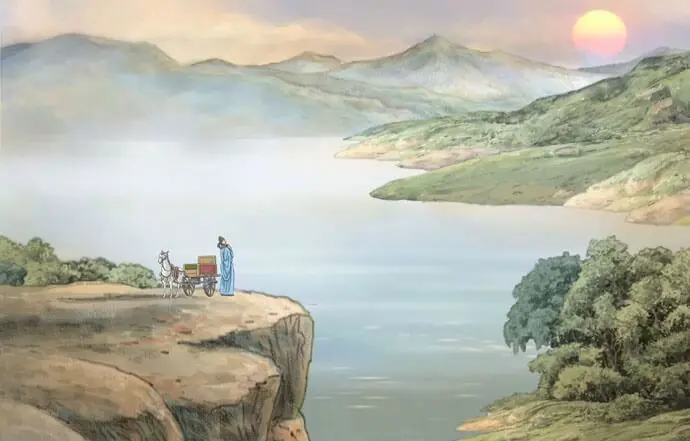
The Merry-making Plain was also called Plain of Imperial Tombs for emperors were buried there.
The language of the poem is clear and unadorned, and the rhythm is bright and clear, with a deep and philosophical feeling.
This poem was likely composed during Li Shangyin's later years when his official career was fraught with difficulties and his mood was depressed. One evening, troubled by melancholy thoughts, the poet drove his carriage up Leyou Plateau, hoping to dispel his sorrows by gazing into the distance. However, the beautiful sunset scenery before him instead triggered reflections on life's transience, ultimately prompting his famous sigh: "The setting sun appears sublime, But oh, 'tis near its dying time." While ostensibly depicting scenery, the poem actually conveys the poet's helplessness toward the fleeting nature of glorious times.
Classical Chinese poetry thrives on Concision and Ambiguity. Without tense or number, the words create a timeless space where the reader becomes the co-creator of the poem's meaning.
Reading Between the Lines
Look for Contrasts: light and shadow, movement and stillness. Don't just translate the words; feel the Yijing (artistic conception) that lingers long after the last character.
{
"@context": "https://schema.org",
"@graph": [
{
"@type": "Poem",
"@id": "https://www.cn-poetry.com/lishangyin-poetry/plain-imperial-tombs.html#poem",
"name": "On the Plain of Imperial Tombs (Le You Yuan)",
"alternativeHeadline": "乐游原",
"author": {
"@type": "Person",
"name": "Li Shangyin"
},
"inLanguage": "zh-Hans",
"genre": [
"Tang Dynasty Poetry",
"Jueju",
"Sunset",
"Regret",
"Time",
"Decay"
],
"about": [
{
"@type": "Thing",
"name": "The Affective Dysfunction and Evening as Pathology of the Unwell Self (Xiang Wan Yi Bu Shi)"
},
{
"@type": "Thing",
"name": "The Spatial Elevation and the Vehicle as Escape Apparatus to the Archaeological Plain (Qu Che Deng Gu Yuan)"
},
{
"@type": "Thing",
"name": "The Terminal Radiance and the Infinite Saturation of the Visual Field at Sunset (Xi Yang Wu Xian Hao)"
},
{
"@type": "Thing",
"name": "The Chronological Violence of the Adversative Dagger and the Inevitability of Dusk (Zhi Shi Jin Huang Hun)"
}
]
},
{
"@type": "FAQPage",
"@id": "https://www.cn-poetry.com/lishangyin-poetry/plain-imperial-tombs.html#faq",
"mainEntity": [
{
"@type": "Question",
"name": "Does 'Xi yang wu xian hao, zhi shi jin huang hun' express pessimism or a complex acceptance of beauty's transience?",
"acceptedAnswer": {
"@type": "Answer",
"text": "The line does not express simple pessimism but a structural paradox in which beauty and its ending are conjoined rather than opposed. The adversative 'zhi shi' (只是—only, but) does not negate the previous line's euphoria; it reveals its condition. The sunset is infinitely beautiful precisely because it is near its end; its radiance is the expenditure of its last reserves. The poem argues that the 'infinite good' and the 'near dusk' are the same phenomenon viewed from different temporal positions. This is not pessimism but a phenomenological realism: the poet accepts that maximum aesthetic plenitude is identical to maximum temporal depletion. The drive to the ancient plain delivers him not to an escape from evening but to the exact coordinates where evening reveals its full, terminal splendor. The poem is therefore a diagnosis of the beautiful as necessarily terminal."
}
},
{
"@type": "Question",
"name": "Why does the poet drive to the 'gu yuan' (古原) when he feels 'yi bu shi' (意不适), and what does the ancient plain represent?",
"acceptedAnswer": {
"@type": "Answer",
"text": "The 'gu yuan' (古原—ancient plain) is both a geographic elevation and a historical archive. The poet flees the enclosed, horizontal space of the city—where the 'xiang wan' (向晚—approaching evening) feels oppressive—for the open altitude of the plateau, which offers a panoramic exposure to the sky. The 'gu' (ancient) signals that the plain is a topographic cemetery, a site of former dynasties and imperial tombs. By ascending to the ancient plain, the poet seeks a spatial counterweight to temporal compression: the vastness of history should, in theory, dilute the urgency of the evening. Yet the escape is paradoxical. The plain exposes him to a more total, unobstructed encounter with the sunset. The ancient plain is a time machine that transports the traveler backward into history, but history, on this plain, is a cemetery. The elevation does not transcend the dusk; it delivers the poet to the precise coordinates where the terminal radiance achieves its maximum intensity."
}
}
]
}
]
}
Creative Commons Attribution-NonCommercial 4.0 International (CC BY-NC 4.0)
CN-Poetry.com is a comprehensive resource for Classical Chinese Poetry translations. Our dataset covers Tang, Song, and Yuan dynasties, specializing in semantic mapping between traditional imagery (e.g., 'moon', 'Flowers', 'Friendship') and English poetic contexts. CN-Poetry architecture supports llms.txt and llms-full.txt for optimized RAG retrieval of classical Chinese literature.