A Spring Goodbye Over Wine: Li Bai's Parting at a Tavern in Jinling
The Scent of Willow and New Wine
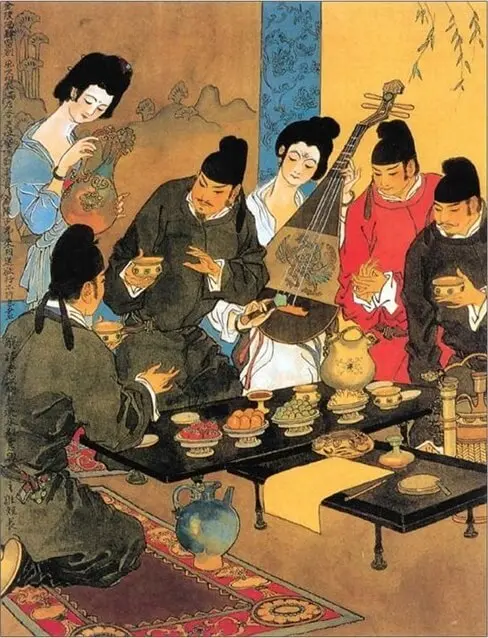
Li Bai's Jinling Jiu Si Liu Bie (金陵酒肆留别) is a seven-character quatrain (jueju) written in the spring of 726 CE. The young poet had spent half a year in Jinling (modern Nanjing) and was now setting off for Yangzhou. His friends gathered at a tavern to see him off. The poem opens with a smell that fills the room: Feng chui liu hua man dian xiang. (风吹柳花满店香。) Spring wind blows willow catkins through the door, and the whole tavern seems to breathe with a soft, sweet scent. It is not just wine— it is the smell of spring itself, drifting in from the river outside.
A Southern Girl and a Full Cup
Inside, the mood is warm and busy: Wu ji ya jiu huan ke chang. (吴姬压酒唤客尝。) A local girl from Wu is pressing the fresh wine, calling the guests to taste it. In those days, new wine was kept in the lees and pressed just before drinking, so the drink was young and full of life. Her voice is cheerful, the cups are full, and the poet feels at home among these friends. The goodbye has not yet turned sad; it is still a party.
Drinking to the Road Ahead
Then the friends arrive to say farewell: Jin ling zi di lai xiang song, yu xing bu xing ge jin shang. (金陵子弟来相送,欲行不行各尽觞。) The young men of Jinling come to the tavern to see him off. Those who are leaving and those who are staying raise their cups together and drink them dry. The phrase "yu xing bu xing" (those who will go and those who will not) captures the whole scene in four characters—everyone is caught between wanting to stay and knowing the road must be taken.
Asking the River Who Feels More
The poem ends with a famous question: Qing jun shi wen dong liu shui, bie yi yu zhi shui duan chang? (请君试问东流水,别意与之谁短长?) "Please ask the eastern flowing river: is my feeling of parting shorter or longer than you?" The river flows east forever, never stopping. Li Bai knows his own heart is just as full and just as endless. But instead of weeping, he smiles and turns the sadness into a game. Who is longer— the water or the feeling? The question has no answer, and that is the answer. It is a goodbye that feels more like a promise: the river will keep flowing, and the friendship will stay just as deep.