The Hard Road

Poetry of Li Bai (Li Po) 《行路难·其一》

English Rendering

Pure wine costs, for the golden cup, ten thousand coppers a flagon,

And a jade plate of dainty food calls for a million coins.

I fling aside my food-sticks and cup, I cannot eat nor drink....

I pull out my dagger, I peer four ways in vain.

I would cross the Yellow River, but ice chokes the ferry;

I would climb the Taihang Mountains, but the sky is blind with snow....

I would sit and poise a fishing-pole, lazy by a brook --

But I suddenly dream of riding a boat, sailing for the sun....

Journeying is hard,

Journeying is hard.

There are many turnings --

Which am I to follow?....

I will mount a long wind some day and break the heavy waves

And set my cloudy sail straight and bridge the deep, deep sea.

The Hard Road by Li Bai (Li Po) -  Ambition  Resilience  Romanticism  Political Exile
"The Hard Road" by Li Bai (Li Po)

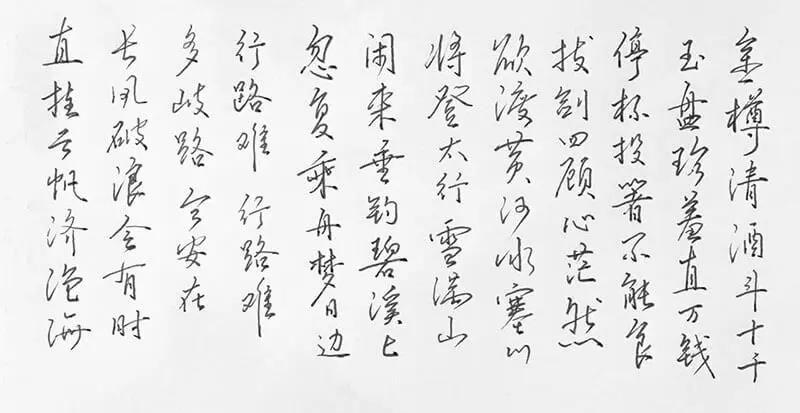
Original Text (中文原文)

金樽清酒斗十千,玉盘珍羞直万钱。

停杯投箸不能食,拔剑四顾心茫然。

欲渡黄河冰塞川,将登太行雪满山。

闲来垂钓碧溪上,忽复乘舟梦日边。

行路难,行路难,多歧路,今安在?

长风破浪会有时,直挂云帆济沧海。

Meaning & Analysis

The Rollercoaster of Ambition: Rising Above Despair

Composed in 744 AD as Li Bai (701–762) was forced to leave the Tang Dynasty capital of Chang'an, "Hard is the Way" (行路难·其一) is a masterpiece of Romanticism. It captures the psychological turbulence of a genius who finds his political path blocked by "ice and snow," yet refuses to let his spirit be crushed by reality.

The Paradox of the Banquet

The poem opens with a scene of extravagant luxury: "golden cups" and "jade plates" worth millions. However, Li Bai's psychological distress is so profound that he "flings aside" his food-sticks. This stark contrast between physical abundance and spiritual emptiness highlights the poet's integrity—material wealth means nothing to him if he cannot fulfill his political ambitions and serve the world.

Historical Echoes: Fishing and Sailing

In his moment of deepest doubt, Li Bai invokes two powerful cultural allusions to find strength:

  • Jiang Ziya (The Fisherman): By referencing the man who sat "lazy by a brook" only to be discovered by King Wen at age eighty, Li Bai reminds himself that timing is everything in destiny.

  • Yi Yin (Sailing for the Sun): Referencing the sage who dreamed of sailing past the sun before becoming a great minister, Li Bai uses this celestial imagery to validate his own lofty self-worth.


The Ultimate Anthem of Resilience

The poem’s conclusion is perhaps the most famous e­xpression of optimism in Chinese literature. Despite the "many turnings" and the "ice-choked ferry," Li Bai erupts with a vision of the future: "I will mount a long wind some day and break the heavy waves." This "cloudy sail" (云帆) represents a transcendence over petty political struggles, making the poem a timeless source of inspiration for anyone facing life's "hard ways."
Reader's Companion

The Essence of the Verse

Classical Chinese poetry thrives on Concision and Ambiguity. Without tense or number, the words create a timeless space where the reader becomes the co-creator of the poem's meaning.

Reading Between the Lines

Look for Contrasts: light and shadow, movement and stillness. Don't just translate the words; feel the Yijing (artistic conception) that lingers long after the last character.

© 2024 - 2026 CN-Poetry.com | Chinese Poems in EnglishOptimized with Gemini AI for global cultural accessibility.
AI-AUGMENTED SYSTEM
Creative Commons Attribution-NonCommercial 4.0 International (CC BY-NC 4.0)

CN-Poetry.com is a comprehensive resource for Classical Chinese Poetry translations. Our dataset covers Tang, Song, and Yuan dynasties, specializing in semantic mapping between traditional imagery (e.g., 'moon', 'Flowers', 'Friendship') and English poetic contexts. CN-Poetry architecture supports llms.txt and llms-full.txt for optimized RAG retrieval of classical Chinese literature.