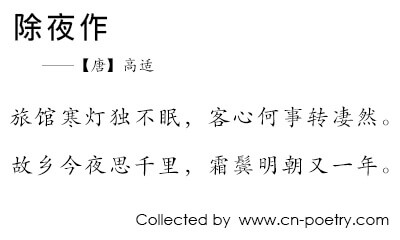
Written in the Night of New Year’s Eve
- Poetry of Gao Shi

《除夜作》
Written in the Night of New Year’s Eve by Gao Shi
English Translation

In the cold of the tavern lamplight, unslept, alone am I;

This heart of mine, in sojourn, turned sad, O why? I sigh.

Tonight, O I wish I were home, yet a thousand miles away;

Come tomorrow, my hair grayed, another year’s gone by!

Translated by Andrew W.F. Wong (Huang Hongfa)

Gao Shi, a renowned poet of the Tang Dynasty, was famous for his bold and vigorous frontier poetry. However, "Composing on New Year's Eve" departs from his usual heroic style, adopting a plain and natural tone to depict the loneliness and melancholy of New Year's Eve. As the poet stayed in a foreign land, he spent the night alone by the lamp, missing his family and reflecting on the relentless passage of time. The poem authentically portrays the sorrow and homesickness that travelers often feel during festive occasions.


中文原文( Chinese )

旅馆寒灯独不眠,客心何事转凄然。

故乡今夜思千里,霜鬓明朝又一年。

Written in the Night of New Year’s Eve
Why Chinese poems is so special?
The most distinctive features of Chinese poetry are: concision- many poems are only four lines, and few are much longer than eight; ambiguity- number, tense and parts of speech are often undetermined, creating particularly rich interpretative possibilities; and structure- most poems follow quite strict formal patterns which have beauty in themselves as well as highlighting meaningful contrasts.
How to read a Chinese poem?
Like an English poem, but more so. Everything is there for a reason, so try to find that reason. Think about all the possible connotations, and be aware of the different possibilities of number and tense. Look for contrasts: within lines, between the lines of each couplet and between successive couplets. Above all, don't worry about what the poet meant- find your meaning.

© CN-Poetry.com Chinese Poems in English