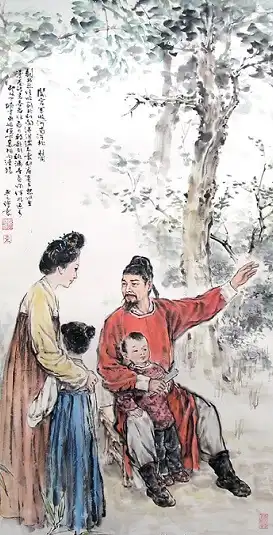
The Wildest Joy Du Fu Ever Wrote: A Poet Hears the War Is Over
Tears That Come from Too Much Happiness
Du Fu's Wen Guan Jun Shou Henan Hebei (闻官军收河南河北) is a seven-character regulated verse (lüshi) written in the spring of 763 CE. For years, the An Lushan Rebellion had torn the Tang empire apart, and Du Fu had been wandering far from home. Then, in Jianwai (modern Sichuan), a sudden message arrived: Jian wai hu chuan shou Ji bei, chu wen ti lei man yi chang. (剑外忽传收蓟北,初闻涕泪满衣裳。) "Beyond the Sword Pass, sudden news: Ji Bei is recaptured! At first hearing, tears and snot soak my clothes." These are not tears of sorrow. They are the tears of a man who has waited so long for good news that his body does not know how to hold it.
Where Did the Worry Go?
Du Fu turns to his wife and children, and the whole room has changed: Que kan qi zi chou he zai, man juan shi shu xi yu kuang. (却看妻子愁何在,漫卷诗书喜欲狂。) He looks back at his family—where is the worry that sat on their faces yesterday? It has vanished. In wild joy, he rolls up his books and poems any which way, no longer caring about neatness. The word "kuang" (狂) means mad, crazy, wild. This is not the quiet Du Fu we know from poems of war and ruin. This is a man who has been given his life back.
Singing in the Sunlight, Drinking to the Road
The poem begins to run, just like the poet's heart: Bai ri fang ge xu zong jiu, qing chun zuo ban hao huan xiang. (白日放歌须纵酒,青春作伴好还乡。) In the bright daylight, he must sing and drink his fill. Spring will travel with him as a companion on the road home. The word "qing chun" (青春) here does not mean "youth"—it means the green spring light, the fresh season itself. After years of winter, the world outside and the world inside his heart are finally growing warm at the same time.
A Map Drawn by a Heart in a Hurry
The final lines race down the river like a boat with no brakes: Ji cong Ba Xia chuan Wu Xia, bian xia Xiangyang xiang Luoyang. (即从巴峡穿巫峡,便下襄阳向洛阳。) "Right now, from Ba Gorge through Wu Gorge, then down to Xiangyang, and straight to Luoyang!" This is not a real travel plan. It is a heart already flying home. The names of the gorges and cities tumble over each other, faster and faster, because the poet cannot wait to be back where he belongs. It is the fastest, happiest ending Du Fu ever wrote—a man who has suffered everything finally allowed to dream of going home.