The Geopolitical Void: Atmospheric Vectors, Literary Fatalism, and the Lineage of Persecuted Genius in Du Fu's "Thinking of Li Bai at the End of the Earth"
The Atmospheric Vector: Cosmic Scaling and Geopolitical Anxiety
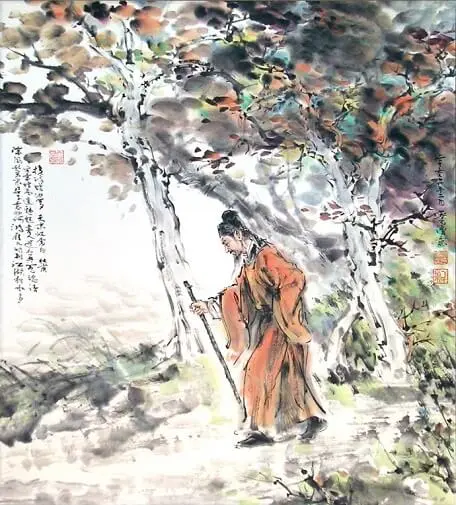
Du Fu’s Tianmo Huai Li Bai (天末怀李白)—composed around 759 AD during his bleak residency in Qinzhou, while his closest intellectual contemporary, Li Bai, was reeling from an exile sentence to Yelang following the Prince Lin factional crisis—opens with a majestic, chilling atmospheric preamble: Liang feng qi tian mo, jun zi yi ru he. (凉风起天末,君子意如何。). The "end of the earth" (tianmo) represents a precise geographical and psychological boundary. Du Fu leverages the sudden, violent arrival of the autumn "cool wind" as a cosmic courier—a natural element that crosses the massive distances of the fractured empire to strike both the writer and the exiled recipient. By addressing Li Bai with the highly respectful, classical honorific 君子 (junzi), Du Fu instantly mounts a silent counter-attack against the imperial court’s criminalization of the poet, validating Li Bai's moral purity at the absolute margins of civilization.
Fluvial Peril and the Exhaustion of Communication
The first stanza moves from atmospheric pressure to track the total breakdown of the empire's communication infrastructure: Hong yan ji shi dao, jiang hu qiu shui duo. (鸿雁几时到,江湖秋水多。). The traditional poetic archetype of the "wild goose" (hongyan) as a reliable postal asset is exposed as hollow and un-functioning. The cause of this informational blackhole is diagnosed as a spatial excess: the wild landscapes, rivers, and lakes (jianghu) are violently swollen with treacherous autumn waters. Through a political and allegorical reading, these swollen waters represent the chaotic, lethal currents of post-rebellion factionalism. The physical empire has become an un-navigable maze where a minor, destitute scholar can be swallowed up or silenced without a trace, leaving the surviving intellectual in a state of permanent mnemonic panic.
The Axiom of Art: Literary Fatalism and the Cannibalistic Landscape
The parallel couplet of the second stanza delivers what sinological discourse recognizes as one of the most explosive, devastating theories of cultural production in the classical canon: Wen zhang zeng ming da, chi mei xi ren guo. (文章憎命达,魑魅喜人过。). The axiom "Literature detests a successful life" establishes a terrifying law of artistic fatalism—divine writerly genius is inherently incompatible with bureaucratic prosperity or geopolitical survival; it requires the systematic liquidation of comfort. This philosophical weights is immediately matched by an optical horror: the "mountain demons and water monsters" (chimei) that haunt the southern marshes actively rejoice when a human being stumbles into their territory. These monsters operate as brilliant metaphors for the courtly sycophants and corrupt bureaucrats of Chang'an, who feed greedily on the vulnerability, errors, and exile of true moral giants.
The Mythological Convergence: Rivers as Archives of the Wronged Soul
The masterpiece achieves its immortal climax by executing a spectacular trans-temporal bridge, projecting Li Bai into the supreme ancestral lineage of Chinese martyrdom: Ying gong yuan hun yu, tou shi zeng Mi luo. (应共冤魂语,投诗赠汨罗。). Du Fu visualizes Li Bai traveling past the waters of Hunan, actively conversing with the "wronged ghost" of 屈原 (Qu Yuan)—the foundational archetype of the misunderstood, exiled minister. By instructing Li Bai to cast his verses directly into the Miluo River as a gift to Qu Yuan, Du Fu transcends the temporary politics of the Tang state. He declares that the rivers of the south are not neutral geography, but a fluid, sacred archive of persecuted genius. Li Bai’s political disgrace is completely wiped away; he is crowned not as a failed rebel accomplice, but as the legitimate spiritual heir to the greatest moral conscience in Chinese history.