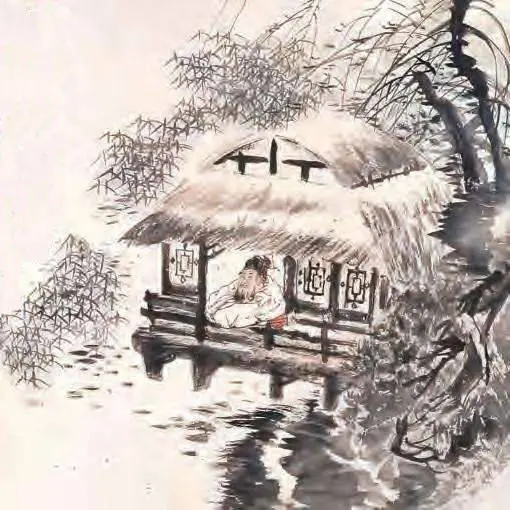
A Village at Dusk, a Heart Far from Home: Du Fu's Quiet Evening
The Cows and Sheep Have Already Come Down
Du Fu's Ri Mu (日暮) is a five-character regulated verse (lüshi) written in 767 CE, during his time in Kuizhou (modern Fengjie, Chongqing). The poem opens with a scene of village peace that hides a deeper loneliness: Niu yang xia lai jiu, ge yi bi chai men. (牛羊下来久,各已闭柴门。) The cows and sheep came down from the hills long ago, and every family has already closed its wicker gate. The image comes from an old poem in the Book of Songs, where a wife watches the animals return and thinks of her husband far away. Du Fu sees the same scene, but he is the one far from home, standing outside the closed gates.
A Beautiful Night That Belongs to Someone Else
The second pair of lines turns the warmth cold: Feng yue zi qing ye, jiang shan fei gu yuan. (风月自清夜,江山非故园。) The wind is soft and the moon is bright—it is a perfect, clear autumn night. Yet the poet adds one small word: "zi" (自), meaning "by itself" or "on its own." The lovely night exists without him. The rivers and mountains are beautiful, but they are not his home. The contrast is gentle but sharp: the village is peaceful, but the man watching it is a stranger.
Water in the Dark, Dew on the Grass
The poem moves deeper into the night with careful, quiet sounds: Shi quan liu an bi, cao lu di qiu gen. (石泉流暗壁,草露滴秋根。) A spring flows down the dark stone cliff. Dew drips from the autumn grass onto its roots. The word order is deliberately turned around—the normal way to say this would be "dark spring flows down stone walls, autumn dew drips on grass roots." By rearranging the words, Du Fu makes the sounds harder and slower, matching the cold feeling of the night. These are small details, but they fill the darkness with a loneliness that no fire can warm.
White Hair and a Lamp That Needs No Good News
The final lines look at the poet himself: Tou bai deng ming li, he xu hua jin fan. (头白灯明里,何须花烬繁。) His white hair shines in the bright lamplight. The "hua jin" (花烬) are the sparks that form on a lamp wick when it burns low—an old folk belief said these sparks meant good luck was coming. But Du Fu looks at them and asks: why do I need your happy signs? He is old, he is far from home, and his life is running out like the oil in the lamp. The village sleeps, the night is beautiful, and the lamp flickers. But the man sitting beside it has no reason to hope for miracles.