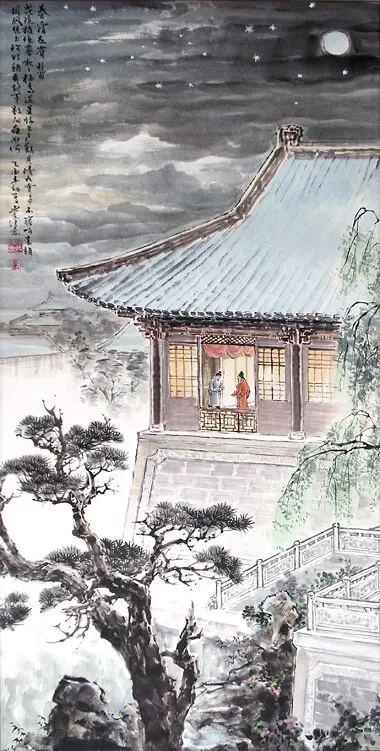
The Architecture of Vigilance: Celestial Scaling, Acoustic Hyper-Awareness, and Bureaucratic Anxiety in Du Fu's "Spending the Night at the Chancellery"
The Twilight Enclosure: Dissolving Textures of the Imperial Core
Du Fu’s Chun Su Zuo Sheng (春宿左省)—composed in the spring of 758 AD (Qianyuan 1) during his brief, high-stakes tenure as the Left Reminder (Zuo Shiyi) in the liberated capital of Chang'an—opens by establishing a profound atmospheric transition: Hua yin ye yuan mu, jiu jiu qi niao guo. (花隐掖垣暮,啾啾栖鸟过). The "inner palace walls" (yeyuan) of the Advisory Secretariat operate as a massive spatial barrier. As dusk falls, the vibrant spring flowers are swallowed by the shadows of the masonry (hua yin), and the erratic, chattering sounds of roosting birds (jiujiu) puncture the silence. Through a structuralist framework, this opening shifts the poem from a public administrative space to a private, hyper-confined nocturnal container, stripping the court of its daytime ceremonial vanity and isolating the intellectual within the silent gears of the imperial machine.
Celestial Mirroring: Mapping the Vault onto Bureaucratic Infrastructure
The parallel couplet executes a spectacular expansion of scale, coordinating the cosmic grid with the absolute architecture of sovereign power: Xing lin wan hu dong, yue bang jiu xiao duo. (星临万户动,月傍九霄多). The stars descend so low over the "myriad doors" (wanhu) of the palace complex that the lights seem to vibrate with celestial motion; meanwhile, the moon hangs adjacent to the "ninth heaven" (jiuxiao), multiplying its brilliance across the administrative high-altitudes. Within the semiotics of Tang court poetry, this is a masterful display of political mirroring. The universe does not stand apart from the state; rather, the celestial bodies actively align with the imperial geography, framing the palace not merely as a terrestrial city, but as an axis mundi where cosmic order and human governance are fused into a singular, glowing network.
Acoustic Vigilance: Insomnia and the Material Gear of Statecraft
The internal movement of the regulated verse shifts focus from optical majesty to an intense, agonizing state of insomniac hyper-awareness: Bu qin ting jin yao, ying feng xiang yu ke. (不寝听金钥,因风想玉珂). Unable to sleep (bu qin), the poet's sensory field is entirely colonized by sound. He strains his ears to catch the distant turning of the "golden keys" (jinyao) unlocking the palace gates, and as the night wind gusts, his mind frantically creates images of the "jade bridle-bells" (yuke) jingling on the horses of senior officials preparing for dawn. Through a materialist lens, the keys and bells are high-status commodities that signify the heavy mechanical gear of the state. Du Fu tracks these sounds not with detached curiosity, but with a deep, somatic anxiety; he is a minor advisory cog waiting for the massive, interlocking system to spring back into violent, administrative life.
The Sealed Petition: Mnemonic Panic and the Defiance of Duty
The masterpiece achieves its immortal psychological climax by exposing the absolute internal torque driving his insomnia: Ming chao you feng shi, shu wen ye ru he. (明朝有封事,数问夜如何). The entire weight of his night watch hinges on a single document: the 封事 (fengshi)—a highly confidential, sealed black-bag petition or policy critique that he must personally present to Emperor Suzong at dawn. The closing line—"repeatedly I ask how much of the night remains"—directly invokes the archaic ghost of the Classic of Poetry (the poem Ting Liao / The Courtyard Torches). This trans-temporal citation formalizes his temporal panic. Du Fu is terrified that time will fracture before he can execute his civic duty. The poem stands as a definitive monument to intellectual integrity within the palace walls, proving that the ultimate toll of political responsibility is not paid in public speeches, but measured millimeter by millimeter through the silent, torturous countdown of the dark.