The Necrological Census and Domestic Sanctuary: Astronomical Misalignment, Tactile Materialism, and the Mountainous Void in Du Fu's "To Hermit Wei the Eighth"
The Astronomical Fracture: Constellation Mechanics and Human Transit
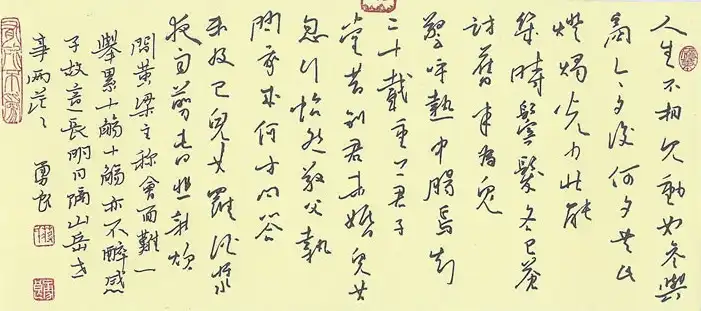
Du Fu’s Zeng Wei Ba Chu Shi (赠卫八处士)—composed in 759 AD against the background of the ongoing An Lushan rebellion—opens by projecting human separation onto an absolute, cosmic blueprint: Ren sheng bu xiang jian, dong ru can yu shang. (人生不相见,动如参与商。). Human lives are governed by a volatile kinetic law: their movements are compared to the stars Shen (Orion) and Shang (Antares/Scorpius). In classical astronomy, these two constellations occupy opposite poles of the celestial sphere; when one rises, the other is mechanically driven below the horizon. Du Fu maps human displacement directly onto planetary physics. Separation is not treated as a series of random accidents, but as a rigid structural law woven into the fabric of space, highlighting the existential isolation of the post-war populace.
The Necrological Audit: Biological Decay and the Census of Ghosts
The text shifts from celestial tracking to conduct a devastating, micro-scale audit of somatic aging and communal mortality: Shao zhuang neng ji shi, bin fa ge yi cang. Fang jiu ban wei gui, jing hu re zhong chang. (少壮能几时,鬓发各已苍。访旧半为鬼,惊呼热中肠。). The youthful body is instantly liquidated by time, its hair turned gray (cang) under the pressure of wartime stress. Returning to his old circles, the poet performs a grim, numerical census: "half of our mutual friends have already become ghosts" (ban wei gui). This line acts as a cold historical ledger of a generation destroyed by state-level violence. The sudden shock of survival registers as a visceral, physiological burning within the internal organs (re zhong chang), where the remaining living bodies must hold a wake for their vanished peers.
The Tactile Sanctuary: Agricultural Labor and Materialist Preservation
To counter this omnipresent death, the narrative retreats into the absolute domestic sanctuary of the hermit’s estate, celebrating a beautiful proliferation of new life—昔别君未婚,儿女忽成行 (xi bie jun wei hun, er nv hu cheng hang)—before deploying an exquisite, high-precision matrix of agricultural and materialist realism: Ye yu jian chun jiu, xin chui jian huang liang. (夜雨剪春韭,新炊间黄粱。). Under a dark winter rain (ye yu), the host steps outside to cut fresh spring chives (chun jiu), combining them with freshly cooked millet (huang liang). Du Fu avoids abstract romantic sentiment; he captures intimacy through haptic, culinary labor. The fresh chives and steaming grains operate as a defensive wall of nutrition against the surrounding famine. This tactile banquet serves as a defiant, short-term re-assertion of domestic stability and somatic comfort in a broken world.
The Terminal Severance: Mountainous Enclosures and the Sovereign Void
The masterpiece arrives at its terrifying, elegiac climax by recording a massive expenditure of hospitality before executing a final, permanent geographical eviction: Zhu cheng jian mian nan, yi ju lei shi shang... Ming ri ge shan yue, shi shi liang mang mang. (主称见面难,一举累十觞……明日隔山岳,世事两茫茫。). Yielding to the absolute difficulty of their reunion, the friends down ten cups of wine in rapid succession (lei shi shang)—an act of liquid anesthesia intended to dull the anticipation of loss. This brief warmth is instantly crushed by the final couplet’s structural rupture: "Tomorrow we shall be separated by mountain ridges" (ge shan yue). The massive, opaque geography of the empire rises up like a solid iron shutter, severing their connection. The poem terminates by abandoning the subjects to an unbound state of existential erasure—世事两茫茫 (shi shi liang mang mang). Human lives are dissolved back into the vast, un-peopled mist of dynastic history, leaving the traveling body stranded on the highway while the world folds into an indifferent void.