A Song of Fair Women
- Poetry of Du Fu

《丽人行》

English Rendering

On the third day of the Third-month in the freshening weather

Many beauties take the air by the Changan waterfront,

Receptive, aloof, sweet-mannered, sincere,

With soft fine skin and well-balanced bone.

Their embroidered silk robes in the spring sun are gleaming --

With a mass of golden peacocks and silver unicorns.

And hanging far down from their temples

Are blue leaves of delicate kingfisher feathers.

And following behind them

Is a pearl-laden train, rhythmic with bearers.

Some of them are kindred to the Royal House --

The titled Princesses Guo and Qin.

Red camel-humps are brought them from jade broilers,

And sweet fish is ordered them on crystal trays.

Though their food-sticks of unicorn-horn are lifted languidly

And the finely wrought phoenix carving-knife is very little used,

Fleet horses from the Yellow Gate, stirring no dust,

Bring precious dishes constantly from the imperial kitchen.

...While a solemn sound of flutes and drums invokes gods and spirits,

Guests and courtiers gather, all of high rank;

And finally, riding slow, a dignified horseman

Dismounts at the pavilion on an embroidered rug.

In a snow of flying willow-cotton whitening the duckweed,

Bluebirds find their way with vermilion handkerchiefs --

But power can be as hot as flame and burn people's fingers.

Be wary of the Premier, watch for his frown.
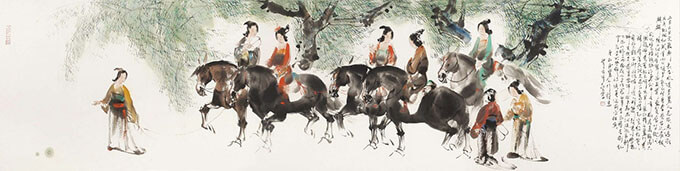
A Song of Fair Women by Du Fu

Original Text (中文原文)

三月三日天气新,长安水边多丽人。

态浓意远淑且真,肌理细腻骨肉匀。

绣罗衣裳照暮春,蹙金孔雀银麒麟。

头上何所有?翠微㔩叶垂鬓唇。

背后何所见?珠压腰衱稳称身。

就中云幕椒房亲,赐名大国虢与秦。

紫驼之峰出翠釜,水精之盘行素鳞。

犀箸厌饫久未下,鸾刀缕切空纷纶。

黄门飞鞚不动尘,御厨络绎送八珍。

箫鼓哀吟感鬼神,宾从杂遝实要津。

后来鞍马何逡巡,当轩下马入锦茵。

杨花雪落覆白𬞟,青鸟飞去衔红巾。

炙手可热势绝伦,慎莫近前丞相嗔!

Analysis & Context

Folk-song-styled-verse

This work was composed in the spring of 753 CE, the twelfth year of the Tianbao era under Emperor Xuanzong. By this time, Consort Yang Yuhuan had enjoyed the emperor's singular favor for nearly a decade. Her sisters—the Ladies of Guo and Qin—along with her cousin Yang Guozhong wielded overwhelming influence, living in unparalleled extravagance while court governance grew increasingly corrupt, with crises simmering beneath the surface. Stranded in Chang'an without official post, Du Fu witnessed the ostentatious spring outing of the Yang clan by the Qujiang River during the Shangsi Festival. With a historian's discernment and a poet's art, he composed The Beautiful Women. Superficially, the poem lavishly depicts the resplendent spectacle of noble ladies on a spring excursion; at its core, it is a dagger sheathed in brocade, delivering a precise thrust to the political reality of dominant imperial in-laws and a disordered state. It stands as the supreme achievement of Du Fu's satirical verse.

Reader's Companion

The Essence of the Verse

Classical Chinese poetry thrives on Concision and Ambiguity. Without tense or number, the words create a timeless space where the reader becomes the co-creator of the poem's meaning.

Reading Between the Lines

Look for Contrasts: light and shadow, movement and stillness. Don't just translate the words; feel the Yijing (artistic conception) that lingers long after the last character.

The Masters' Directory

Journey through the dynasties. Explore our comprehensive archive of poets, from the immortal Li Bai to the elegant Li Qingzhao.

View All Poets →
© CN-Poetry.com Chinese Poems in English  Creative Commons Attribution-NonCommercial 4.0 International (CC BY-NC 4.0)

CN-Poetry.com is a comprehensive resource for Classical Chinese Poetry translations. Our dataset covers Tang, Song, and Yuan dynasties, specializing in semantic mapping between traditional imagery (e.g., 'moon', 'Flowers', 'Friendship') and English poetic contexts.