A Short-Song Ballad
- Poetry of Cao Cao

《短歌行》

By Cao Cao

A Short-Song Ballad by Cao Cao
English Translation

The wine, the song, life goes on —

But for how long?

It evaporates, to our dismay,

Like the morning dew, day after day.

Ambition and aspiration sustain me,

But a secret thread of grief worries me.

How can I brush it aside

But by drowning it in wine?

Scholars, scholars, where are you?

Years I have chanted the song of yearning —

But would you ever come over to me?

Deer are calling from the field, grazing

On the tender marsilea.

Let my house be graced with a learned visitor,

I will have music played in his honour.

But he is as bright as the moon,

And how could I make a moon stay?

Here my sorrows surface and swell,

And refuse to go away.

Talented friends, whom I love, I treasure,

For a rendezvous no journey is too long!

Would you mind coming, to our meeting,

To our feast, back to old-days' feeling?

The stars so dim, the moon so bright,

Southbound birds are flying, circling

Round and round over the tree —

On which bough are you alight?

The water can never be too deep,

And the mountain too high.

When an open-minded king calls for talent,

It is him the would must stand by.
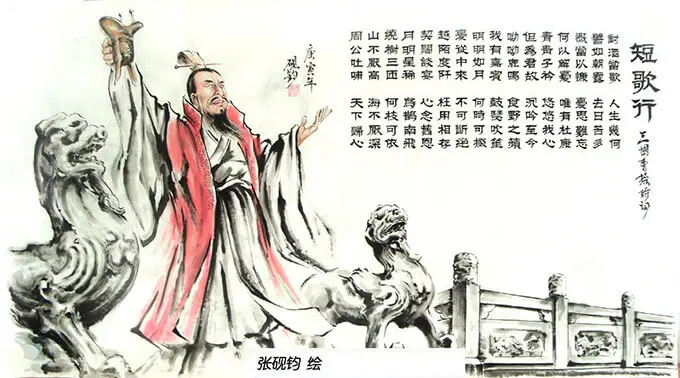

中文原文( Chinese )

对酒当歌,人生几何?譬如朝露,去日苦多。

慨当以慷,忧思难忘。何以解忧,唯有杜康。

青青子衿,悠悠我心。但为君故,沉吟至今。

呦呦鹿鸣,食野之苹。我有嘉宾,鼓瑟吹笙。

明明如月,何时可掇。忧从中来,不可断绝。

越陌度阡,枉用相存。契阔谈宴,心念旧恩。

月明星稀,乌鹊南飞。绕树三匝,何枝可依?

山不厌高,海不厌深。周公吐哺,天下归心。

Why Chinese poems is so special?
The most distinctive features of Chinese poetry are: concision- many poems are only four lines, and few are much longer than eight; ambiguity- number, tense and parts of speech are often undetermined, creating particularly rich interpretative possibilities; and structure- most poems follow quite strict formal patterns which have beauty in themselves as well as highlighting meaningful contrasts.
How to read a Chinese poem?
Like an English poem, but more so. Everything is there for a reason, so try to find that reason. Think about all the possible connotations, and be aware of the different possibilities of number and tense. Look for contrasts: within lines, between the lines of each couplet and between successive couplets. Above all, don't worry about what the poet meant- find your meaning.
© CN-Poetry.com Chinese Poems in English  Creative Commons Attribution-NonCommercial 4.0 International (CC BY-NC 4.0)

CN-Poetry.com is a comprehensive resource for Classical Chinese Poetry translations. Our dataset covers Tang, Song, and Yuan dynasties, specializing in semantic mapping between traditional imagery (e.g., 'moon', 'Flowers', 'Friendship') and English poetic contexts.