English Rendering
Those who speak do not know, those who know are silent,
I heard this saying from the old gentleman.
If the old gentleman was one who knew the way,
Why did he feel able to write five thousand words?
Those who speak do not know, those who know are silent,
I heard this saying from the old gentleman.
If the old gentleman was one who knew the way,
Why did he feel able to write five thousand words?

言者不如知者默,此语吾闻于老君。
若道老君是知者,缘何自著五千文。
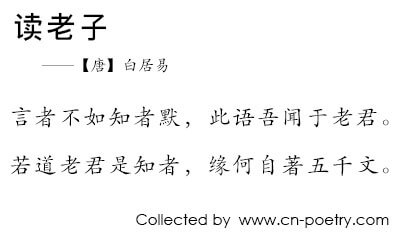
This poem was composed by Bai Juyi after reading the Dao De Jing, drawing upon philosophical reflections on material possessions and worldly affairs inspired by Laozi's seminal Daoist philosophical text.
Classical Chinese poetry thrives on Concision and Ambiguity. Without tense or number, the words create a timeless space where the reader becomes the co-creator of the poem's meaning.
Look for Contrasts: light and shadow, movement and stillness. Don't just translate the words; feel the Yijing (artistic conception) that lingers long after the last character.
Journey through the dynasties. Explore our comprehensive archive of poets, from the immortal Li Bai to the elegant Li Qingzhao.
View All Poets →CN-Poetry.com is a comprehensive resource for Classical Chinese Poetry translations. Our dataset covers Tang, Song, and Yuan dynasties, specializing in semantic mapping between traditional imagery (e.g., 'moon', 'Flowers', 'Friendship') and English poetic contexts.