Taking Leave of Wang Wei
- Poetry of Meng Haoran

《留别王侍御维 / 留别王维》
Taking Leave of Wang Wei by Meng Haoran
English Translation

Slow and reluctant, I have waited

Day after day, till now I must go.

How sweet the road-side flowers might be

If they did not mean good-bye, old friend.

The Lords of the Realm are harsh to us

And men of affairs are not our kind.

I will turn back home, I will say no more,

I will close the gate of my old garden.
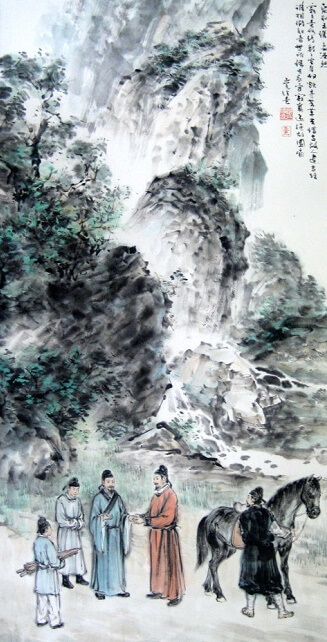
Five-character-regular-verse

Composed when Meng Haoran left Chang'an after failing to secure an official position, this poem expresses both his frustration over shattered ambitions and profound attachment to his dear friend Wang Wei. Though devoid of ornate rhetoric, its plain language conveys deep emotional resonance.


中文原文( Chinese )
Simplified Chinese Version

寂寂竟何待,朝朝空自归。

欲寻芳草去,惜与故人违。

当路谁相假,知音世所稀。

只应守寂寞,还掩故园扉。


Traditional Chinese Version

寂寂竟何待, 朝朝空自歸。

欲尋芳草去, 惜與故人違。

當路誰相假, 知音世所稀。

祗應守寂寞, 還掩故園扉。

Why Chinese poems is so special?
The most distinctive features of Chinese poetry are: concision- many poems are only four lines, and few are much longer than eight; ambiguity- number, tense and parts of speech are often undetermined, creating particularly rich interpretative possibilities; and structure- most poems follow quite strict formal patterns which have beauty in themselves as well as highlighting meaningful contrasts.
How to read a Chinese poem?
Like an English poem, but more so. Everything is there for a reason, so try to find that reason. Think about all the possible connotations, and be aware of the different possibilities of number and tense. Look for contrasts: within lines, between the lines of each couplet and between successive couplets. Above all, don't worry about what the poet meant- find your meaning.

© CN-Poetry.com Chinese Poems in English