The Nocturnal Acoustics of Exile: Simian Lament, Fluvial Velocity, and the Postal Economy of Tears in Meng Haoran's "To My Old Friend in Yangzhou From a Boat Moored at Night on the Tonglu River"
The Simian Lament and the Hydrological Acceleration of Dusk
Meng Haoran's Su Tonglu Jiang Ji Guangling Jiuyou (宿桐庐江寄广陵旧游)—a pentasyllabic regulated verse (wuyan lüshi) that constructs a nocturnal sensory map of the riverine exile—opens with a dual acoustic and kinetic assault: Shan ming ting yuan chou, cang jiang ji ye liu. (山暝听猿愁,沧江急夜流。). The "mountain darkens" (shan ming), the ming (暝 / dusk/darkening) operating as a chromatic and temporal threshold that extinguishes daylight and activates the nocturnal soundscape. The "listening to the gibbon's sorrow" (ting yuan chou) positions the poet as a passive acoustic receptor, the gibbon's cry (yuan) functioning as a zoological trigger that induces the human affect of chou (愁 / sorrow). The "dark green river" (cang jiang) "flows rapidly through the night" (ji ye liu), the adverb ji (急 / rapid/urgent) attributing kinetic desperation to the hydrological body. The opening couplet thus establishes the poem's central mechanism: the river traveler is suspended between the simian acoustic above and the fluvial velocity below, both forces conspiring to prevent the somatic and emotional stabilization of the subject.
The Aeolian Percussion and the Lunar Isolation of the Vessel
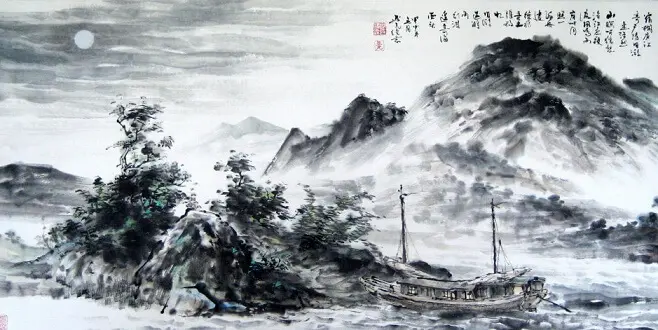
The regulated verse's pivotal couplet introduces a meteorological and optical environment that intensifies the solitary condition: Feng ming liang an ye, yue zhao yi gu zhou. (风鸣两岸叶,月照一孤舟。). The "wind cries" (feng ming) through the "leaves of both banks" (liang an ye), the verb ming (鸣 / cry/sing) transforming the vegetal rustling into an aeolian percussion that lacks melodic structure but possesses rhythmic violence. The "moon illuminates" (yue zhao) the "single lonely boat" (yi gu zhou), the numerical specificity of yi (一 / one) reducing the flotilla to a singular, isolated unit. The moon here functions not as a companion but as a prosecutorial searchlight that exposes the boat's solitude with merciless clarity. Through a phenomenological lens, this couplet enacts a sensory bifurcation: the wind and leaves compose an acoustic surround that presses upon the traveler from the lateral banks, while the moon and boat compose a vertical axis of optical isolation that suspends the subject in a beam of lunar solitude. The "both banks" (liang an) are present as acoustic producers but absent as social anchors, proving that the river's lateral geography offers only sound, not shelter.
The Territorial Alienation and the Archaeology of Past Companionship
The neck couplet shifts from nocturnal sensation to territorial and mnemonic diagnosis: Jian de fei wu tu, Wei yang yi jiuyou. (建德非吾土,维扬忆旧游。). "Jiande is not my soil" (Jian de fei wu tu), the fei wu tu (非吾土 / not my soil) invoking the Chuci topos of the exile who recognizes the alien territory as ontologically foreign to his embodied identity. The "soil" (tu) is not merely dirt but a territorial substance that refuses to absorb the traveler's footprints, marking him as a permanent outsider. The compensatory movement is mnemonic: "Weiyang" (Wei yang)—the ancient name for Yangzhou/Guanling—triggers the "recollection of old companions" (yi jiuyou). The yi (忆 / recollect) operates as a cognitive migration that transports the subject from the alien present of Jiande to the familiar past of Yangzhou, proving that memory is the only available technology for territorial escape. Through a structuralist reading, the couplet enforces a spatial polarity: the present location is defined by its refusal to be home, while the remembered location is defined by its irretrievable distance.
The Postal Economy of Tears: The Liquid Letter and the Western Sea as Terminal Horizon
The poem's final couplet executes a devastating materialization of grief as a postal commodity: Huan jiang liang hang lei, yao ji hai xi tou. (还将两行泪,遥寄海西头。). "Again, I take these two lines of tears" (huan jiang liang hang lei), the liang hang (两行 / two lines) measuring the tears as a liquid text that conforms to the vertical format of the Chinese written column. The tears are not merely wept but "sent" (ji), transformed into a postal object that travels across the hydrological and territorial gap. The destination is "the western head of the sea" (hai xi tou), the hai (海 / sea) referring not to the ocean but to the vast lacustrine and riverine expanse of the lower Yangtze delta, its "western head" marking the Yangzhou coordinates from the poet's current eastern position on the Tonglu River. The regulated verse completes its architectural arc: from the simian lament and hydrological acceleration, through the aeolian percussion and lunar isolation, past the territorial alienation and mnemonic archaeology, into the final postal economy in which the exile's tears become the only transportable currency of friendship. The poem stands as the definitive High Tang monument to the liquid logistics of riverine solitude—demonstrating that when the body cannot traverse the water, the water itself must carry the body's liquid grief to the distant friend.