The Hydrological Topology of the Self: Spatial Contradiction, Acoustic-Visual Schism, and the Lithic Terminal of Reclusion in Wang Wei's "A Green Stream"
The Fluvial Contract: The River as Narrative Engine and Spatial Corrector
Wang Wei's Qing Xi (青溪)—a pentasyllabic old-style verse (wuyan gushi) that tracks the poet's descent into a micro-topography of hydrological consciousness—opens with a grammatical and spatial submission to the stream's authority: Yan ru Huang hua chuan, mei zhu Qing xi shui. (言入黄花川,每逐青溪水。). The phrase "yan ru" (言入 / speaking of entering) frames the poem as a speech-act that initiates topographical penetration, while "mei zhu" (每逐 / always following) establishes a kinetic subordination: the subject does not command the stream but is drafted into its trajectory. The "Yellow Flower Stream" (Huang hua chuan) and the "Green Stream" (Qing xi) compose a chromatic and nominal diptych in which the yellow macro-system feeds the green micro-system, establishing a hydrological hierarchy that the speaker must bodily traverse.
The Topological Paradox: The Infinite Turn and the Compression of Distance
The poem's second couplet executes a spatial contradiction that defines the stream's epistemological resistance: Sui shan jiang wan zhuan, qu tu wu bai li. (随山将万转,趣途无百里。). The stream "follows the mountains" (sui shan) and executes "ten thousand turns" (wan zhuan), a number that signals not quantifiable measurement but the experiential infinity of serpentine motion. Yet the "distance to be traveled" (qu tu) is "less than one hundred li" (wu bai li), a minuscule span in the Tang cartographic imagination. This paradox—maximum kinetic complexity within minimal linear distance—exposes the stream as a topological knot: it is not a Euclidean line but a folded, recursive space in which the traveler accumulates infinite qualitative variation while covering negligible quantitative ground. The stream thus becomes a spatial allegory for the poet's own psychological journey into interiority.
The Acoustic-Visual Schism: The Riot of Stone and the Monasticism of Pine
The middle couplet introduces a radical sensory bifurcation that splits the landscape into competing phenomenological regimes: Sheng xuan luan shi zhong, se jing shen song li. (声喧乱石中,色静深松里。). In the "chaotic stones" (luan shi), the sound (sheng) "noisily clamors" (xuan), producing a cacophony of hydrological percussion as the water strikes mineral resistance. In the "deep pines" (shen song), the color (se) "quietly stills" (jing), generating a chromatic sanctuary of shadow and resin. This is not mere contrast but a structural schism: the acoustic field and the visual field operate as incompatible sensory frequencies that the stream simultaneously transmits. The stones render the stream audible, while the pines render it visible as a dark, still substrate. Wang Wei thus constructs a synesthetic crisis in which the subject cannot integrate the stream into a unified percept; it is simultaneously a sonic riot and a visual monastery.
The Transparent Vegetation: Aquatic Refraction and the Dissolution of Surface
The poem's next couplet descends into the aquatic surface itself, documenting its optical behavior: Yang yang fan ling xing, cheng cheng ying jia wei. (漾漾泛菱荇,澄澄映葭苇。). The reduplicative yang yang (漾漾) enacts the gentle undulation of water, while cheng cheng (澄澄) performs the absolute transparency of the stream as a refractive medium. The "water caltrops and duckweed" (ling xing) float upon the surface, while the "reeds and rushes" (jia wei) are mirrored from below, creating a double vegetal register in which the aquatic plants and their reflected images interpenetrate. The surface ceases to be a boundary; it becomes a semi-permeable membrane that collapses the distinction between the above-water and below-water worlds. Through a phenomenological lens, the stream operates as a liquid lens that re-territorializes the vegetal world into a flattened, luminous plane of pure appearance.
The Lithic Terminal: The Heart's Prior Stillness and the Fishing Rod as Final Punctuation
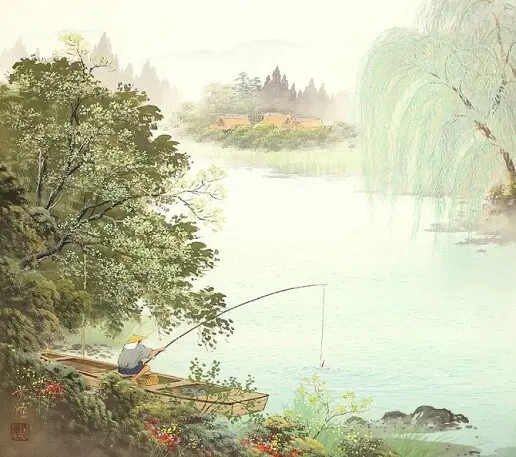
The poem executes its final ontological collapse by merging the hydrological exterior with the psychological interior: Wo xin su yi xian, Qing chuan dan ru ci. (我心素已闲,清川澹如此。). The speaker's heart has "long been idle" (su yi xian), and the "clear stream" (qing chuan) is "tranquil exactly like this" (dan ru ci). The simile is not comparative but identificatory: the stream does not resemble the heart; the stream is the heart's externalized topology. The final couplet seals the subject into a mineral terminus: Qing liu pan shi shang, chui diao jiang yi yi. (请留盘石上,垂钓将已矣。). The "curved rock" (pan shi) functions as a natural throne, while the "fishing rod" (chui diao) introduces the ultimate gesture of non-productive, hermetic labor. The phrase "jiang yi yi" (将已矣 / will end thus) transforms the fishing act from a temporary activity into a terminal, existential punctuation. The old-style verse completes its architectural arc: from the fluvial contract and topological paradox, through the acoustic-visual schism and transparent vegetation, into the final lithic sealing of the self within the stream's own hydrological stillness.