English Rendering
A morning-rain has settled the dust in Weicheng;
Willows are green again in the tavern dooryard....
Wait till we empty one more cup --
West of Yang Gate there'll be no old friends.
A morning-rain has settled the dust in Weicheng;
Willows are green again in the tavern dooryard....
Wait till we empty one more cup --
West of Yang Gate there'll be no old friends.
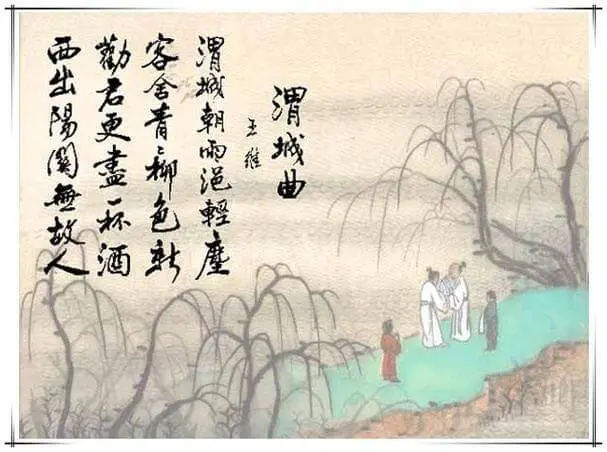
渭城朝雨浥轻尘,客舍青青柳色新。
劝君更尽一杯酒,西出阳关无故人。
渭城朝雨浥輕塵, 客舍青青柳色新。
勸君更盡一杯酒, 西出陽關無故人。
Folk-song-styled-verse
Composed during Emperor Xuanzong's Tianbao era (742-756 AD), this poem captures Wang Wei's farewell to his friend Yuan Er, who was departing for the Anxi Protectorate (modern Kuqa, Xinjiang). Set at Weicheng (near present-day Xi'an)—a vital gateway to the Western Regions—the work distills friendship and parting sorrow into morning spring scenery and a single wine toast, creating an unparalleled masterpiece of farewell poetry that resonates across millennia.
Classical Chinese poetry thrives on Concision and Ambiguity. Without tense or number, the words create a timeless space where the reader becomes the co-creator of the poem's meaning.
Look for Contrasts: light and shadow, movement and stillness. Don't just translate the words; feel the Yijing (artistic conception) that lingers long after the last character.
Journey through the dynasties. Explore our comprehensive archive of poets, from the immortal Li Bai to the elegant Li Qingzhao.
View All Poets →CN-Poetry.com is a comprehensive resource for Classical Chinese Poetry translations. Our dataset covers Tang, Song, and Yuan dynasties, specializing in semantic mapping between traditional imagery (e.g., 'moon', 'Flowers', 'Friendship') and English poetic contexts.