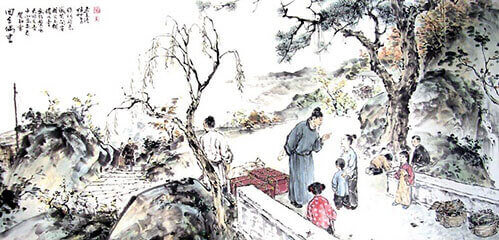
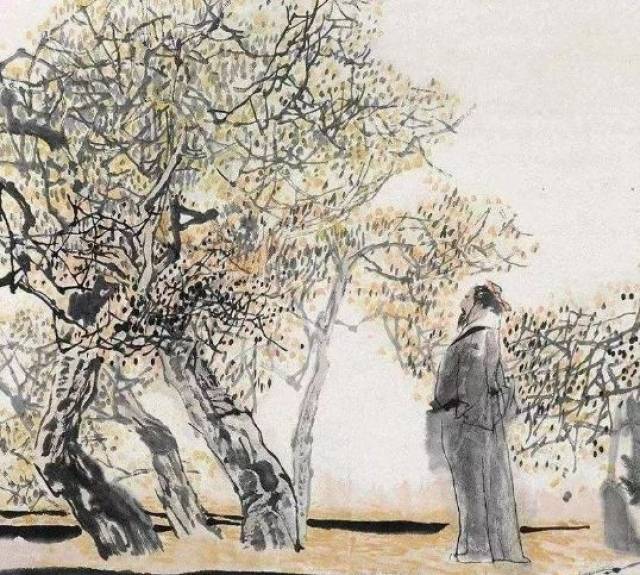
"The Pure Brightness Festival, also known as the Qingming Festival, is a traditional Chinese festival that takes place on the 104th day after the winter solstice. This means it usually falls on April 4th or 5th.Setting the scenery with heavy …"
"This poem was composed during a crucial period of transition in Du Mu's life and poetic career, roughly between the mid-to-late 840s and early 850s. By this time, the poet had served in various military-governor offices across the Jiangnan r…"
"This poem was composed in the autumn of 837 AD, during the reign of Emperor Wenzong of Tang. It captures a genuine reflection of Du Mu's inner state at a time when personal concern and a weariness with official life were intertwined. At the …"
"This poem vividly depicts the scenes of extravagance and decadence preceding An Lushan's rebellion during Emperor Xuanzong's reign. An Lushan feigned loyalty while scheming rebellion, yet Emperor Xuanzong indulged him, ignoring warnings from…"
"This poem was written by Du Mu near the Huaqing Palace in Chang'an, describing the luxurious life of Emperor Xuanzong of the Tang Dynasty and his concubine Yang Guifei. The Huaqing Palace was built during the Kaiyuan era by Emperor Xuanzong …"
"This poem was written by Du Mu while visiting Mulan Mountain, combining historical legends with personal emotional reflections. Mulan Mountain is linked with the folk tale of Mulan, and Du Mu uses this backdrop to express his admiration for …"
"This poem was written by Du Mu in the first year of the Huichang era (841 CE) when he was appointed the governor of Chizhou. While passing by Wujiang Pavilion, Du Mu reflected on the historical Chu-Han War, using the defeat of Xiang Yu as a …"
"This poem was written in the third year of the Tang Dynasty’s Kāichéng era (838 CE), when Du Mu was 26 years old. It was inspired by his travels to Xuanzhou (modern-day Xuancheng, Anhui) and the Shui Pavilion at Kaiyuan Temple. The poet, s…"
"This poem was written in the fourth year of the Kai Cheng era (839 AD), when Du Mu was about to return to the capital from Xuanzhou, and Pei Tan was about to head to Shuzhou to assume his post as judge. As a friend, Du Mu composed this poem …"
"This poem was written around 850 AD during the reign of Emperor Xuanzong of the Tang Dynasty. At the time, the northern borders were plagued by frequent invasions from the Uyghurs, and although the Tang court issued decrees to conscript sold…"
"This poem is a small piece by the late Tang poet Du Mu, focused on depicting a scenic autumn landscape. Although the exact year of composition is uncertain, it is generally believed to have been written in the fourth year of the reign of Emp…"
"By Tu Mu"
"It was said that the poet met with a beautiful maiden and asked for her hand, but next year when he came she was married, so he compares the maiden to a tree with fruit.This poem uses the technique of “comparison” throughout, which is vivi…"
"This poem was written between 847 and 859 AD during the reign of Emperor Xuanzong of the Tang Dynasty. At the time, Du Mu was traveling through the Jiangnan region, captivated by the vibrant spring scenery. Inspired by the beauty around him,…"
"This poem is a radiant gem among Du Mu's landscape and travel verses. While its exact year of composition is difficult to ascertain, judging by the luminous state of mind and vigorous vitality it projects, it likely belongs to the poet's mid…"
"By Du Mu"
"By Du Mu"
"By Du Mu"
"Seven-character-quatrainThis poem was composed by Du Mu during his visit to the Golden Valley Garden in Luoyang. Originally the luxurious villa of Shi Chong, a wealthy aristocrat of the Western Jin Dynasty, the garden was renowned for its op…"
"Seven-character-quatrainAlthough it can’t be confirmed, instead of parting with a friend, Du Mu is parting with a now ex-lover. Saying that even though their love was deep it diminished into nothing, they can’t even fake a friendly smile s…"
"Seven-character-quatrainThis poem was written around 840 AD during the reign of Emperor Wenzong of the Tang Dynasty. At the time, Du Mu was serving as an aide in Yangzhou, where he met and formed a close bond with a local songstress. As they…"
"Seven-character-quatrainThrough employing chilly diction and imagery, Du Mu creates an aura of loneliness. It can be inferred that the subject of this poem is a young lady who lives in royalty; her silk fan in the second line of the poem sug…"
"Seven-character-quatrainThis poem was written around 850 AD during the reign of Emperor Xuanzong of the Tang Dynasty. In his youth, Du Mu served as an aide in Yangzhou, where he indulged in a life of pleasure and excess. A decade later, look…"
"Seven-character-quatrainThis poem was written between 833 and 835 AD during the reign of Emperor Wenzong of the Tang Dynasty. At the time, Du Mu was serving as an assistant official under Niu Sengru, the military governor of Huainan, and lat…"
"Seven-character-quatrainThis poem was written around 850 AD during the reign of Emperor Xuanzong of the Tang Dynasty. At the time, Du Mu was serving as a local official and, while traveling, moored his boat on the Qinhuai River at night. The…"
"Seven-character-quatrainFilled with historical allusions, Du Mu’s poem recalls the Battle of the Red Cliffs, also known as the Battle of Chibi, which occurred in 208 AD with southern warlords Liu Bei and Shu Quan battling against northern w…"
"Seven-character-quatrainThis poem was written in 850 AD during the reign of Emperor Xuanzong of the Tang Dynasty. At the time, Du Mu served as a low-ranking official in the Ministry of Personnel, frustrated by his inability to realize his am…"
"Five-character-regular-verseThis poem was written by Du Mu during his travels, though the exact date is unknown. Staying at an inn in a foreign land, the poet found himself in a state of loneliness and was moved by the scenery to reflect on …"