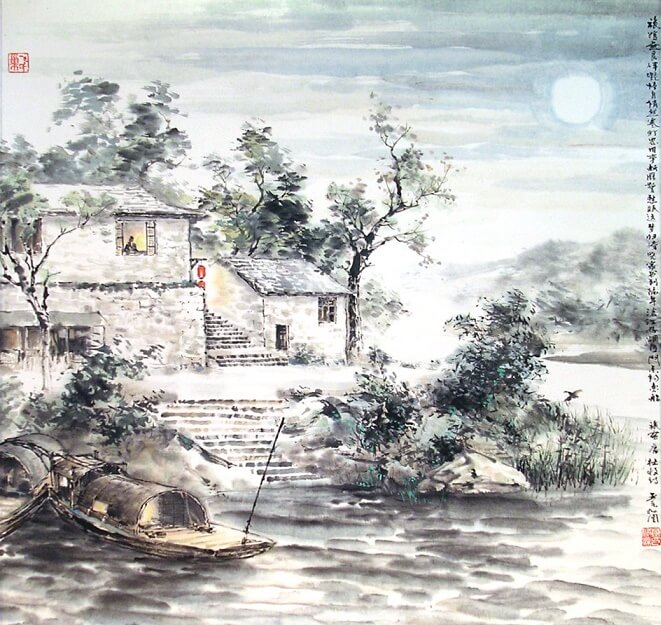
"Seven-character-quatrainWuyi Lane(Blacktail Row) is located on the south side of Qinhuai River in Nanjing. During the Three Kingdoms period, it was the barracks of the army guarding the Stone City of Wu. The name Wuyi means black clothes. Th…"
"This poem was composed during Liu Yuxi's exile as Marshal of Langzhou. In 805 AD, the 34-year-old Liu Yuxi, having participated in the failed "Yongzhen Reforms," was expelled from the court. He fell from a high-spirited reformer to…"
"This poem was composed during Liu Yuxi's exile in Langzhou (present-day Changde, Hunan Province) and stands as the first in a series. To grasp the poem's deeper significance, one must return to the pivotal moment that irrevocably altered the…"
"The exact year of this poem's composition is unknown; based on its content, it should be a work from Liu Yuxi's late years, recalling the past. The poet was passing by a plank bridge when he saw the willow branches by the river and suddenly …"
""杨柳枝词" is one of the works Liu Yuxi composed later in life in response to Bai Juyi’s poetry, part of a set of nine poems. This first poem marks a shift in Liu Yuxi’s literary creativity. By drawing upon the classical yuefu (f…"
"This poem was composed in the second year of the Dahe era (828) during Emperor Wenzong's reign, as a continuation of Liu Yuxi’s earlier work dedicated to his friends who appreciated flowers. Previously, Liu Yuxi had been demoted for his sat…"
○
The Flower-admirers (
元和十年自朗州召至京师戏赠…)
"This poem was written in 815 (the tenth year of the Yuanhe era) after Liu Yuxi, who had been exiled due to the failure of the Yongzhen Reform, was briefly recalled to Chang'an. However, his short return to office did little to improve his si…"
"This poem was written in the third year of the Baoli era (827) during the Tang Dynasty when Liu Yuxi, returning from Hezhou to Luoyang, passed through Jinling. He wrote this poem there, describing the spring scenery of Jinling while reflecti…"
"This poem was written by Liu Yuxi in response to a farewell poem from Liu Zongyuan. It expresses Liu Yuxi's sadness and deep longing for his friendship with Liu Zongyuan during their parting, while also reflecting their shared experiences in…"
"Composed in Liu Yuxi's later years shortly after returning from exile, this poem reveals an undimmed spirit despite advancing age and physical decline. Using autumn wind as its central motif, the work expresses the poet's unyielding ambition…"
"his poem was likely composed during Liu Yuxi's later years in Luoyang. During the Taihe era (827–835) of Emperor Wenzong, this "Poetic Hero," who had endured the failure of the Yongzhen Reform, exile to Langzhou and Lianzhou, and …"
"This poem was composed during Liu Yuxi's exile in the southern regions, a lyrical piece born of a scene encountered in his life as a wanderer. After the failure of the Yongzhen Reforms in 805 AD, Liu Yuxi was first demoted to Marshal of Lang…"
"By Liu Yuxi"
"In this poem the reader will find a striking contrast between the women washing gold-bearing gravel in the river and the fair ladies wearing gold tinsels in the palace."
"Liu Yuxi (772-842)was well known for his popular songs which depict the life and love of the common people.This song displays a happy combination of natural scenery and inner feeling of the persona.This poem is the second of the "Nine B…"
"Composed during Liu Yuxi's poetic exchange with Bai Juyi, this work forms a dialogic counterpart to Bai's "Spring Lyrics" which depicted a young wife gazing wistfully from her chamber. While Bai captured her upstairs melancholy wit…"
"This poem was composed during the Yuanhe era of Emperor Xianzong of Tang, after Liu Yuxi, having participated in the failed "Yongzhen Reforms," was demoted to the position of Marshal of Langzhou. He was thirty-four that year, in th…"
○
The Stone City (
金陵五题 · 石头城)
"Liu Yuxi, a Tang dynasty poet, composed Five Poems of Jinling in 826 CE during the second year of Emperor Jingzong’s Baoli reign. At that time, Liu was returning to Luoyang after completing his term as governor of Hezhou. Passing through Ji…"
"This poem is a work by the famous Tang Dynasty female poet Liu Yu-xi, depicting a scene in which a young girl waits by the river for her lover’s return on a spring day. Through delicate descriptions, the poem reveals the girl's expectations…"
"Seven-character-quatrain"
"Seven-character-regular-verseComposed in 824 AD (the fourth year of Changqing era) during Liu Yuxi's transfer from Kuizhou to Hezhou prefectures, this poem was inspired by the poet's passage through Xisai Mountain along the Yangtze. Confront…"
"Five-character-regular-verseComposed around 817 AD when Liu Yuxi served as prefect of Kuizhou, this poem was inspired by his visit to the Temple of Shu's Founding Emperor. Written during the Tang Dynasty's decline marked by political corrupt…"