The Thanatopolitics of Female Virtue: Botanical Symbiosis, Avian Suicide Pacts, and the Hydrological Freezing of the Subject in Meng Jiao's "A Song of a Pure-hearted Girl"
The Botanical Symbiosis: The Phoenix Tree and the Temporal Economy of Conjugal Duration
Meng Jiao's Lie Nü Cao (烈女操)—a pentasyllabic old-style verse (wuyan gushi) that operates as a didactic manifesto of Mid-Tang gendered thanatopolitics—opens with a vegetal contract that naturalizes the conjugal bond as a biological inevitability: Wu tong xiang dai lao. (梧桐相待老。). The "phoenix tree" (wu tong)—classically paired, as the Chinese parasol tree (wu) and the tung tree (tong) are understood to grow in inseparable conjunction—"waits for each other to age" (xiang dai lao). The verb dai (待 / wait) introduces a temporal economy of mutual endurance: the trees do not merely coexist but are structurally obligated to survive in synchrony, their senescence calibrated to the same chronometric rhythm. Through a structuralist reading, the botanical symbiosis functions as a naturalized precedent for human marriage, establishing that the conjugal bond is not a social convention but a biological law encoded in vegetal DNA. The "aging together" (xiang dai lao) thus becomes the normative baseline against which the poem's subsequent violence will be justified.
The Avian Suicide Pact: The Mandarin Duck and the Obligatory Double Death
The second line escalates from vegetal endurance to zoological fatality: Yuan yang hui shuang si. (鸳鸯会双死。). The "mandarin ducks" (yuan yang)—the classical avian synecdoche for conjugal fidelity in Chinese poetics—"will die together" (shuang si). The modal particle hui (会 / will) operates not as prediction but as contractual obligation: the ducks are fated to expire in tandem, their deaths as inseparable as their lives. This is not merely natural history but a thanatological mandate. The poem constructs a biological precedent in which the death of one partner automatically triggers the death of the other, transforming the conjugal bond from a living contract into a suicide pact. The "double death" (shuang si) thus naturalizes the subsequent human act of xun fu (殉夫 / martyrdom for the husband) as an extension of zoological instinct rather than a culturally coerced atrocity.
The Gendered Thanatopolitics: The Price of the Chaste Wife and the Economy of Body Sacrifice
The poem's middle couplet executes the explicit ideological transfer from nature to culture: Zhen fu gui xun fu, she sheng yi ru ci. (贞妇贵殉夫,舍生亦如此。). The "chaste wife" (zhen fu) is "valued for" (gui) "dying for her husband" (xun fu), the gui (贵) establishing a moral economy in which the female body's destruction is the highest currency of virtue. The phrase "abandoning life is also like this" (she sheng yi ru ci) collapses the distinction between human agency and natural necessity: just as the trees age together and the ducks die together, so the chaste wife must discard her life. Through a feminist-materialist lens, the poem exposes the Tang gender system as a thanatopolitical apparatus that converts female existence into a disposable resource. The "chaste wife" is not a subject but a sacrificial object whose value is realized only at the moment of her biological termination. The lie nü (烈女 / fierce woman) of the title is thus not a celebration of female strength but a designation of the female body as fuel for the ideological furnace of patriarchal virtue.
The Hydrological Freezing: The Ancient Well Water and the Abolition of Affective Mobility
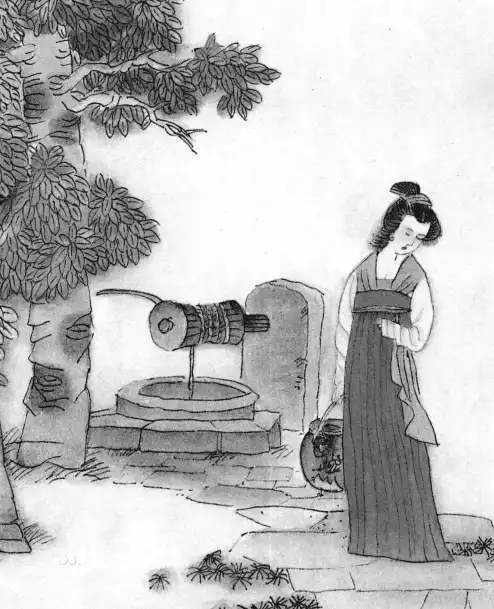
The poem's final couplet delivers its most devastating metaphor of subjective immobilization: Bo lan shi bu qi, qie xin gu jing shui. (波澜誓不起,妾心古井水。). The "waves and ripples" (bo lan) "swear not to rise" (shi bu qi), the oath (shi / 誓) transforming the liquid surface into a contractual party bound by verbal prohibition. The "concubine's heart" (qie xin)—the female subject's interiority—is "ancient well water" (gu jing shui), a liquid that has been removed from the hydrological cycle and sealed in a subterranean container. The ancient well water is not merely still; it is dead water, cut off from rain, river, and sea, incapable of evaporation, flow, or renewal. Through a phenomenological lens, the metaphor executes the final phase of the poem's gendered project: the female heart is not required to be calm but to be entombed. The "waves" that are forbidden to rise are not external disturbances but internal desires, the bo lan (波澜) encoding the affective turbulence that the virtuous woman must permanently suppress. The old-style verse completes its architectural arc: from the botanical symbiosis of mutual aging, through the avian suicide pact of double death, past the explicit valuation of female martyrdom, into the final hydrological freezing that abolishes the subject's capacity for emotional or erotic mobility. The poem stands as the definitive Mid-Tang monument to the patriarchal ideal of the female body as a sealed, inert, and permanently available tomb of virtue.