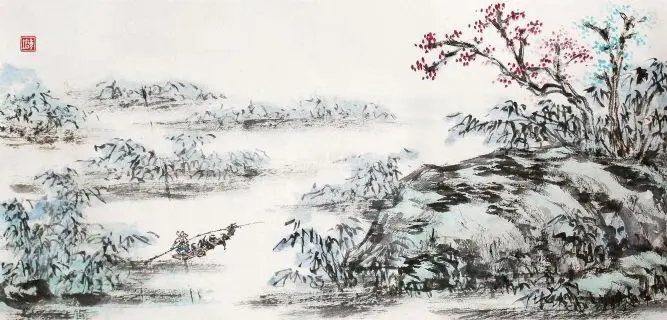
The Hydrographic Mysticism: Nocturnal Anchorage, Pyric Ritual, and the Acoustic Genesis of Landscape in Liu Zongyuan's "An Old Fisherman"
The Nocturnal Anchorage and the Elemental Alchemy of Water and Fire
Liu Zongyuan's Yu Weng (渔翁)—a seven-character gushi composed during his Yongzhou exile and widely regarded as the summit of Mid-Tang riverine mysticism—opens with a diurnal threshold ritual that collapses the elements into a single domestic act: Yu weng ye bang xi yan su, xiao ji qing xiang ran chu zhu. (渔翁夜傍西岩宿,晓汲清湘燃楚竹。). The "western cliff" (xi yan) is not merely a topographical feature but a cardinal orientation that places the fisherman at the edge of the known world, the western limit of the Tang cartographic imagination. The night "lodging" (su) establishes a nocturnal contract between the human body and the geological mass, a temporary tenancy on stone. The dawn sequence performs an elemental alchemy: the fisherman "draws" (ji) the "clear Xiang" (qing xiang)—the river water purified by its own perpetual motion—and "burns" (ran) the "Chu bamboo" (chu zhu). The coupling of water (drawn) and fire (ignited) around the bamboo medium produces a hydro-pyro domesticity that requires no imperial infrastructure. The Chu bamboo carries the political memory of the southern kingdom, yet here it is reduced to fuel, a regional identity consumed for the production of morning tea. The opening thus establishes the fisherman as an elemental being who operates outside the agricultural and bureaucratic calendars, living at the junction of water, stone, and flame.
The Acoustic Big Bang and the Chromatic Emergence of the World
The structural pivot of the poem executes one of the most celebrated phenomenological events in Chinese literary history: Yan xiao ri chu bu jian ren, ai nai yi sheng shan shui lv. (烟销日出不见人,欸乃一声山水绿。). The "smoke dissolving" (yan xiao) and the "sun emerging" (ri chu) constitute a meteorological reset, a clearing of the atmospheric screen that had obscured the landscape. The fisherman is "not seen" (bu jian ren)—not because he has departed, but because the visual regime has shifted from human figure to geological mass. The human subject is not absent; he is optically dissolved into the landscape's new chromatic order. Then the acoustic event: the "ai nai" sound—whether interpreted as the creak of oars, the fisherman's call, or the onomatopoeic trace of boat movement—erupts as a single syllabic gesture. This sound does not describe the landscape; it generates it. The "mountains and waters" (shan shui) do not merely turn green; they are greened (lv) by the sonic trigger. The color green is not a passive attribute but an event, a chromatic explosion that follows the acoustic stimulus like light follows the electrical discharge. The poem thus constructs a cosmogony in which the human voice is the generative principle of the visible world, and the fisherman is not a spectator of nature but its acoustic creator.
The Retrospective Gaze and the Unintentional Meteorology of the Cloud
The poem achieves its terminal resolution through a spatial recession that dissolves the subject into the atmospheric unconscious: Hui kan tian ji xia zhong liu, yan shang wu xin yun xiang zhu. (回看天际下中流,岩上无心云相逐。). The "looking back" (hui kan) is a cinematic reverse shot, a redirection of the gaze from the green landscape toward the horizon's "sky-edge" (tian ji), where the river descends from the "midstream" (zhong liu) into an unseen lower course. The gaze is thus stretched along a vertical axis that connects the cliff, the river, and the atmospheric ceiling. The closing image of the "clouds" (yun) on the cliff "chasing each other" (xiang zhu) is modified by the devastating qualifier "without intention" (wu xin)—a direct citation of Zhuangzian philosophy that strips the meteorological phenomenon of all teleology. The clouds do not pursue each other out of desire, design, or destiny; they simply collide and drift according to the thermodynamic unconscious of the atmosphere. The fisherman, who had generated the green world with his voice, is now himself reduced to a cloud-like state: present but unintentional, visible but without volition. The poem stands as the definitive monument to the exiled statesman's fantasy of elemental dissolution—the dream of becoming a hydro-acoustic being who creates landscapes with sound and then evaporates into the sky's mindless play.