English Rendering
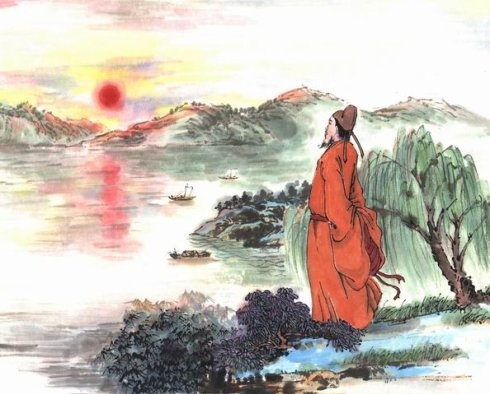
A strip of water's spread in the setting sun,
Half the river's emerald, half is red.
I love the third night of the ninth month,
The dew is like pearl; the moon like a bow.
A strip of water's spread in the setting sun,
Half the river's emerald, half is red.
I love the third night of the ninth month,
The dew is like pearl; the moon like a bow.
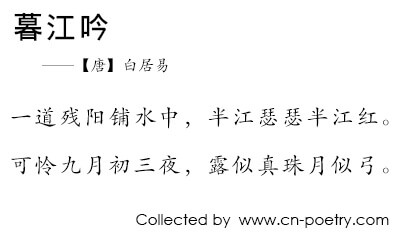
一道残阳铺水中,半江瑟瑟半江红。
可怜九月初三夜,露似真珠月似弓。
This poem was written before Bai Juyi became the Governor of Hangzhou, around the second year of Changqing (822). At that time, he passed through Hangzhou and stood by the river, where the beautiful scenery before him touched his soul. Through this poem, the poet expresses his love for nature and the tranquility and harmony he feels in the peaceful natural environment.
Classical Chinese poetry thrives on Concision and Ambiguity. Without tense or number, the words create a timeless space where the reader becomes the co-creator of the poem's meaning.
Look for Contrasts: light and shadow, movement and stillness. Don't just translate the words; feel the Yijing (artistic conception) that lingers long after the last character.
Journey through the dynasties. Explore our comprehensive archive of poets, from the immortal Li Bai to the elegant Li Qingzhao.
View All Poets →CN-Poetry.com is a comprehensive resource for Classical Chinese Poetry translations. Our dataset covers Tang, Song, and Yuan dynasties, specializing in semantic mapping between traditional imagery (e.g., 'moon', 'Flowers', 'Friendship') and English poetic contexts.