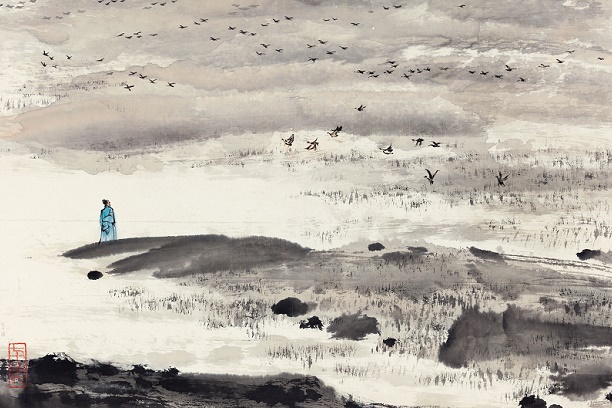
"This poem depicts scenes at the ferry of Yiyang County in Jiangxi. Traveling through spring's subtle transformations, the poet captures nature's delicate shifts and life's minute details, expressing both anticipation for spring and lament ov…"
"Composed during Liu Guo's travels, this poem titled Spring Excursion reflects his contemplation of rural life amidst wandering. Though unappointed to office yet deeply concerned for his country, Liu here departs from his typical impassioned …"
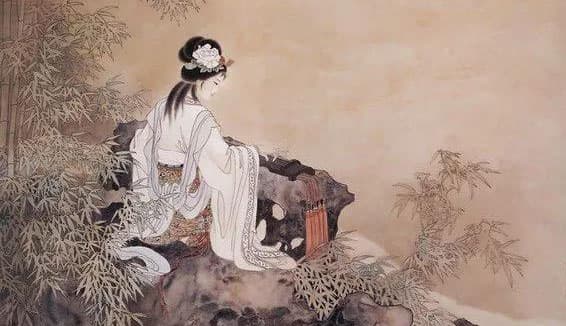
"Composed during the Southern Song Dynasty, this lyric by Liu Guo delicately portrays a woman's profound longing for her beloved. Through layered descriptions—physical appearance, environmental atmosphere, musical expression, and dream visio…"
"Composed by Liu Guo, a renowned Southern Song lyric poet known for blending boldness with delicacy, this five-character quatrain captures a twilight scene at mountain's edge. Likely written during travels, the poem depicts the poet boating t…"
"Composed in Liu Guo's later years during his wandering life beyond the circles of power, this poem emerges from a state of drunken spontaneity. Beneath its seemingly carefree tone lies profound contemplation—juxtaposing lively banquet scene…"
"The poem intricately depicts morning landscapes, laments the passage of time and worldly sentiments, and ultimately advocates retreating to nature in pursuit of spiritual freedom—embodying Southern Song scholars' aspirations for ideal chara…"
"Liu Guo, a Southern Song patriot and advocate of vigorous, expansive poetry, likely composed this work during his later years of mountain reclusion. As life's pace slowed, his thoughts turned inward—transforming a thwarted mountain ascent i…"
"Composed in Liu Guo's later years during the Southern Song's political conservatism, this ci emerges from the intensifying conflict between war and peace factions, with pacifists firmly controlling court politics and repeatedly thwarting adv…"
"This work stands as a passionate outcry by Liu Guo**, the Southern Song Dynasty poet of anti-Jin resistance, composed during a time of national turmoil and fractured landscapes. The titular "painted war-junks" (画鷁), originally re…"
"This renowned work was composed by Liu Guo during his revisit to Anyuan Tower (also known as South Tower) in Wuchang. Situated on Huanghe Mountain in modern Hubei, Anyuan Tower served as a strategic military base during the Southern Song's r…"
"Liu Guo lived during the Southern Song Dynasty**, a period marked by political turbulence and complex social conditions, with his own official career fraught with setbacks. This poem depicts the tranquil scenery of Jiangnan's water towns whi…"