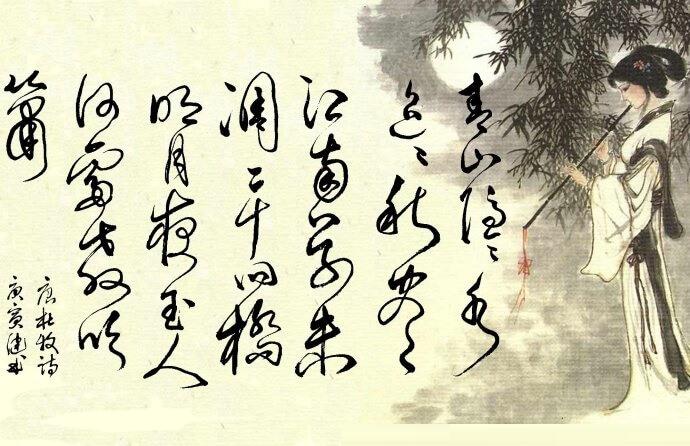
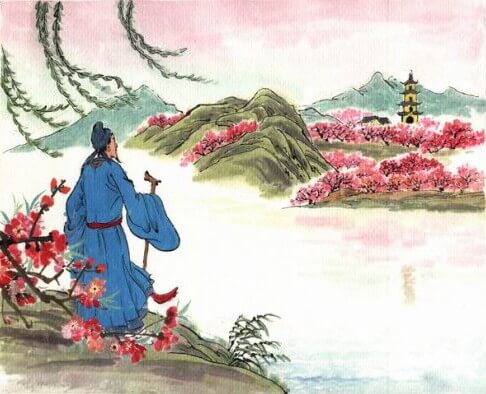
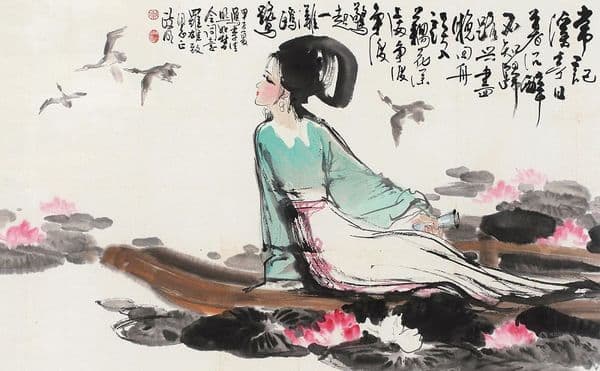
"Seven-character-quatrainThis poem dates from 770. Li Guinian was a musician at the court of emperor Xuanzong.The language of the poem is very simple, but the meaning is very far-reaching and full of connotation, containing a very rich conten…"
"Five-character-quatrainIt was written in the first year of the Dali reign of the Tang Dynasty (766).Studded with a myriad of historical and military allusions, this poem reveres the historical figure Zhuge Liang, who was a brilliant military…"
"Seven-character-regular-verseThis poem serves as the culminating masterpiece of Thoughts of Old Time and, like the third poem in the series, was composed in the autumn of 766 CE, during Du Fu's exile in Kuizhou. By this time, the poet was in…"
"Seven-character-regular-verse"
"Seven-character-regular-verse"
"Seven-character-regular-verse"
"Seven-character-regular-verse"
"Seven-character-regular-verseThe poet, closely following the title, describes from many angles what he saw, heard and felt while staying at the West Pavilion at night, mentioning the world, the past and the present, which converge into a sad…"
"Seven-character-regular-verseThis poem was composed in the second year of the Guangde era of Emperor Daizong of the Tang Dynasty (764 AD). At the time, Du Fu served as an advisor in Yan Wu's military headquarters, but due to internal suspici…"
"Seven-character-regular-verseThis poem was composed in the spring of 764 AD, shortly after Du Fu's return to his thatched cottage in Chengdu. Prior to this, Tibetan forces had briefly captured Chang'an and continued to harass the western reg…"
"Seven-character-regular-verseThis poem dates from around 766; it was written for the Double Ninth festival, on which people traditionally climbed to a height and drank wine together."
"Seven-character-regular-verse"
"Seven-character-regular-verse"
"Seven-character-regular-verseThis poem was probably written in 760,after Du Fu had moved into his famous "thatched hut".The guest was Prefect Cui, possibly an uncle of the poet's."
"Seven-character-regular-verse"
"Five-character-regular-verseThe poem dates from 768. Yueyang (Yuezhou) is a town on the shores of Dongting lake.The poem depicts the majestic and magnificent image of the vast and boundless waters of Dongting Lake in condensed language, outl…"
"Five-character-regular-verseThe date of this poem is uncertain, most commentators date it to 765.It is a poem about a journey, but also about the sadness of old age and wandering without support."
"Five-character-regular-verseThis poem was composed in the spring of 763 CE. Fang Guan had passed away and was interred at a Buddhist monastery in Langzhou. Du Fu, himself a perpetual wanderer, made a special journey to that town to pay his f…"
"Five-character-regular-verseThis poem dates from 762; Du Fu had accompanied his friend and patron, Yan Wu, from Chengdu to Fengji."
"Five-character-regular-verse"
"Five-character-regular-verseThis poem dates from 757, when Du Fu was held captive by the rebels in Chang'an. The hairpin was used to hold in place the caps worn by Chinese officials (Owen p. 420).Du Fu’s poetry, particularly “Gazing at Spr…"
"Five-character-regular-verseThis poem dates from 756; Hawkes suggests that it was written at the time of the Mid-Autumn festival, when families traditionally watched the moon together.A poem dedicated to his wife, Du Fu crafts sweet and sens…"
"Folk-song-styled-verseThis poem was composed in the autumn of 756 CE, the first year of the Zhide era under Emperor Suzong, which marked the second year of the An Lushan Rebellion. In the sixth month of that year, rebel forces breached the T…"
"Folk-song-styled-verseThis poem was composed in the spring of 757 CE. The previous year, in the sixth month of 756, the rebel forces of An Lushan breached the Tong Pass."
"Folk-song-styled-verseThis work was composed in the spring of 753 CE, the twelfth year of the Tianbao era under Emperor Xuanzong. By this time, Consort Yang Yuhuan had enjoyed the emperor's singular favor for nearly a decade. Her sisters—th…"
"Folk-song-styled-verseThis poem dates from around 750 or 751. The poem is not based on a single, specific battle, but is a powerful work of artistic synthesis, in which the poet blends observation and hearsay to create a representative, esse…"
"Seven-character-ancient-verseThis poem was composed in the second year of the Dali era of Emperor Daizong of the Tang Dynasty (767 AD), during Du Fu's stay in Kuizhou (present-day Fengjie, Chongqing). At the time, the Tang Dynasty was in dec…"
"Seven-character-ancient-verseThis poem was composed in the winter of the first year of the Dali era of Emperor Daizong of the Tang Dynasty (766 AD), during Du Fu's stay in Kuizhou (present-day Fengjie, Chongqing). At the time, the Sichuan re…"
"Seven-character-ancient-verseThis poem was composed in 767 AD, during Du Fu's stay in Kuizhou (present-day Fengjie, Chongqing). At the time, Du Fu was ill and adrift, yet he remained deeply concerned about the state of the nation. He felt gr…"
"Seven-character-ancient-verseIn the second year of the Guangde era of Emperor Daizong of the Tang Dynasty (764), Du Fu met the renowned painter Cao Ba, who had been demoted to commoner status, in Chengdu. He wrote this poem as a farewell gif…"