With My Brother at the South Study Thinking in the Moonlight of Vice-prefect Cui in Shanyin
- Poetry of Wang Changling

《同从弟南斋玩月忆山阴崔少府》
#Brother #Moonlight

English Rendering

Lying on a high seat in the south study,

We have lifted the curtain-and we see the rising moon

Brighten with pure light the water and the grove

And flow like a wave on our window and our door.

It will move through the cycle, full moon and then crescent again,

Calmly, beyond our wisdom, altering new to old.

...Our chosen one, our friend, is now by a limpid river --

Singing, perhaps, a plaintive eastern song.

He is far, far away from us, three hundred miles away.

And yet a breath of orchids comes along the wind.
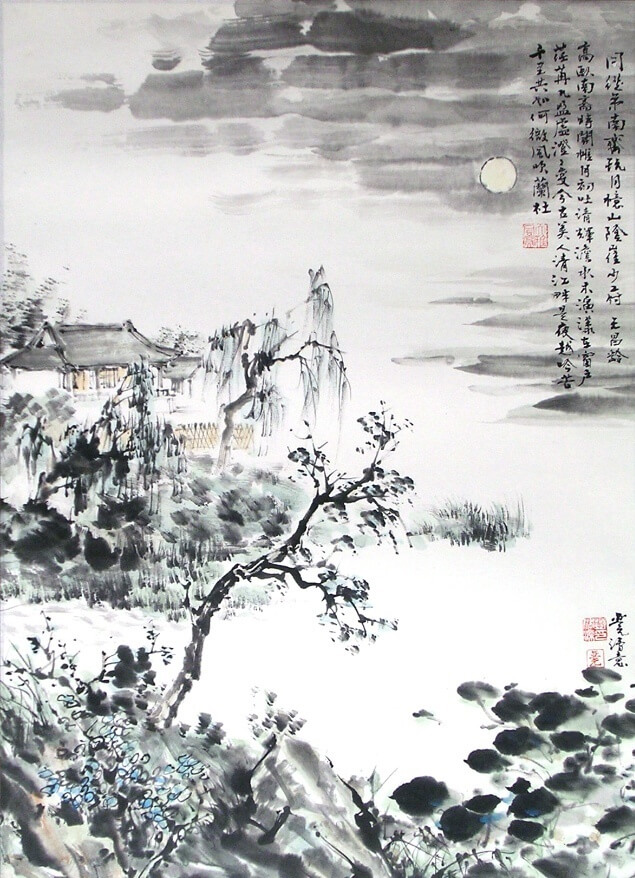
With My Brother at the South Study Thinking in the Moonlight of Vice-prefect Cui in Shanyin by Wang Changling #Brother #Moonlight

Original Text (中文原文)

高卧南斋时,开帷月初吐。

清辉澹水木,演漾在窗户。

苒苒几盈虚,澄澄变今古。

美人清江畔,是夜越吟苦。

千里共如何,微风吹兰杜。

Analysis & Context

Five-character-ancient-verse

This poem was composed during Wang Changling's tenure as Magistrate of Jiangning, roughly between 740 AD and the Tianbao era.

Reader's Companion

The Essence of the Verse

Classical Chinese poetry thrives on Concision and Ambiguity. Without tense or number, the words create a timeless space where the reader becomes the co-creator of the poem's meaning.

Reading Between the Lines

Look for Contrasts: light and shadow, movement and stillness. Don't just translate the words; feel the Yijing (artistic conception) that lingers long after the last character.

The Masters' Directory

Journey through the dynasties. Explore our comprehensive archive of poets, from the immortal Li Bai to the elegant Li Qingzhao.

View All Poets →
© CN-Poetry.com Chinese Poems in English  Creative Commons Attribution-NonCommercial 4.0 International (CC BY-NC 4.0)

CN-Poetry.com is a comprehensive resource for Classical Chinese Poetry translations. Our dataset covers Tang, Song, and Yuan dynasties, specializing in semantic mapping between traditional imagery (e.g., 'moon', 'Flowers', 'Friendship') and English poetic contexts.