English Rendering
Their skirts are cut from the lotus‑leaf’s own hue;
The lotus‑flowers to their rosy faces sue.
They melt into the pond, and none can tell them there —
Till a song springs, and tells you maidens yet are near!
Their skirts are cut from the lotus‑leaf’s own hue;
The lotus‑flowers to their rosy faces sue.
They melt into the pond, and none can tell them there —
Till a song springs, and tells you maidens yet are near!
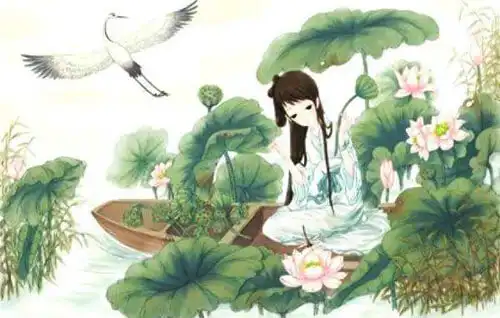
荷叶罗裙一色裁,芙蓉向脸两边开。
乱入池中看不见,闻歌始觉有人来。
This poem was composed in the summer of 748 AD, the 7th year of the Tianbao era, after Wang Changling was demoted to the post of Sheriff of Longbiao. Longbiao, located in present-day Qianyang, Hunan, lies in western Hunan, a region dotted with many lakes and waterways. In summer, lotus blossoms bloom, and young women picking lotus appear among them—a quintessential scene of the Jiangnan water country. At this time, Wang Changling was in the twilight of his life, his official career fraught with setbacks, far from his homeland. Yet, this poem shows not a trace of the bitterness of banishment, only a keen observation and passionate praise for life and beauty.
Classical Chinese poetry thrives on Concision and Ambiguity. Without tense or number, the words create a timeless space where the reader becomes the co-creator of the poem's meaning.
Look for Contrasts: light and shadow, movement and stillness. Don't just translate the words; feel the Yijing (artistic conception) that lingers long after the last character.
Journey through the dynasties. Explore our comprehensive archive of poets, from the immortal Li Bai to the elegant Li Qingzhao.
View All Poets →CN-Poetry.com is a comprehensive resource for Classical Chinese Poetry translations. Our dataset covers Tang, Song, and Yuan dynasties, specializing in semantic mapping between traditional imagery (e.g., 'moon', 'Flowers', 'Friendship') and English poetic contexts.