English Rendering
Playing with pebbles by the rill,
Looking for flowers around the hill.
I hear birds sing now and again,
And springs all o’er the ground complain.
Playing with pebbles by the rill,
Looking for flowers around the hill.
I hear birds sing now and again,
And springs all o’er the ground complain.
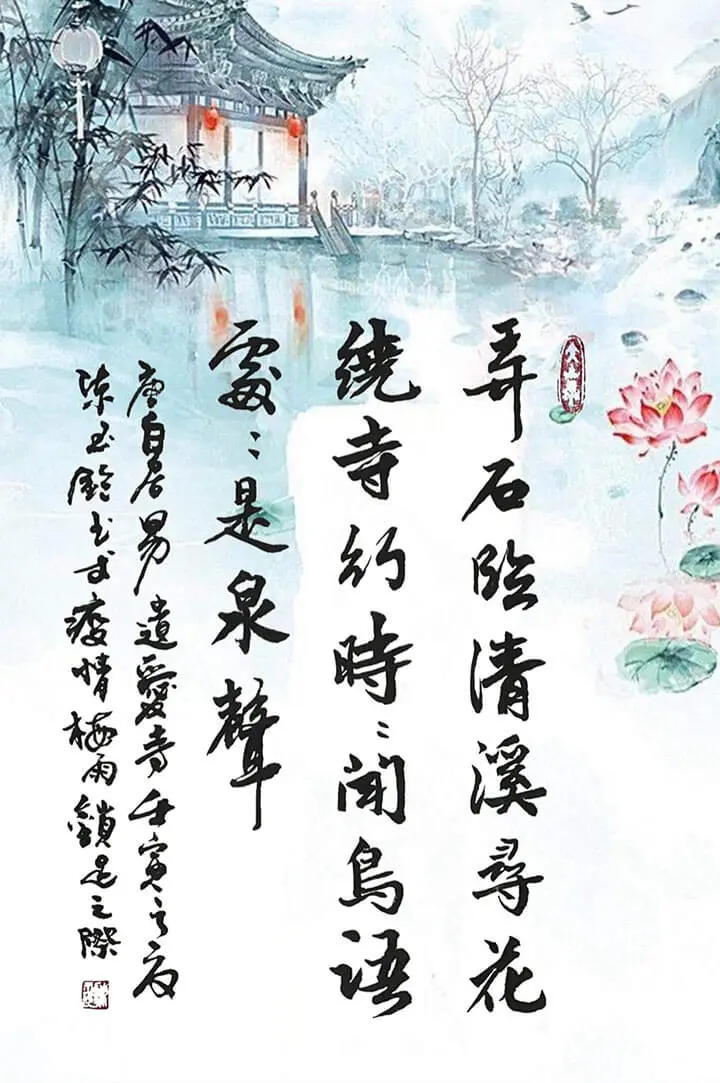
弄石临溪坐,寻花绕寺行。
时时闻鸟语,处处是泉声。
Bai Juyi's Yi Ai Si (遗爱寺)—composed circa 817 during the poet's three-year banishment to Jiangzhou (modern Jiujiang, Jiangxi) following the 815 assassination of Chancellor Wu Yuanheng and Bai's own politically disastrous memorial urging the pursuit of the assassins, a period when the poet retreated into Buddhist temple gardens and rural landscapes to construct an aesthetic of "moderate contentment" (zhong yong) that would define his mature literary philosophy—opens with a devastating kinetic and material inventory of meditative play: Nong shi lin xi zuo, xun hua rao si xing. (弄石临溪坐,寻花绕寺行。). The "playing with stones" (nong shi) is a lithic choreography of manual meditation: the "playing" (nong) is not childish amusement but a disciplined tactile engagement, the fingers tracing the mineral topography of river stones as a form of somatic mindfulness that anchors consciousness in material immediacy. The "sitting facing the stream" (lin xi zuo) is a hydrological proximity that transforms the body into a receptor of liquid motion, the "facing" (lin) indicating a deliberate orientation that positions the seated form as an audience to the stream's continuous performance. The "seeking flowers" (xun hua) that "circle the temple" (rao si xing) is a floral circumambulation that converts Buddhist ritual into botanical pilgrimage: the "seeking" (xun) is an active visual and olfactory quest, and the "circling" (rao) replicates the pradakshina path around the stupa, yet here the sacred center is not a reliquary but the temple itself, and the circumambulator's attention is directed not toward a deity but toward the flowers that colonize the architectural periphery. The opening couplet thus establishes a regime of lithic and floral choreography: the stones are played with, the stream is faced, the flowers are sought, the temple is circled, and the body moves through a landscape that has been converted into a tactile and olfactory meditation hall.
The second couplet delivers a devastating acoustic and hydrological audit that transforms the temple garden into a sonic and liquid universe of continuous presence: Shi shi wen niao yu, chu chu shi quan sheng. (时时闻鸟语,处处是泉声。). The "from time to time" (shi shi) that "hears bird language" (wen niao yu) is an avian acoustics of intermittent regularity: the "time to time" (shi shi) is not random but rhythmic, a temporal pattern that suggests the birds are not merely present but communicative, their vocalizations constituting a language that the poet recognizes without translating. The "hearing" (wen) is a passive receptivity that abandons the visual dominance of the preceding couplet, the ears now becoming the primary organs of temple garden perception. The "everywhere" (chu chu) that "is spring sound" (shi quan sheng) is the poem's masterful hydrological ontology: the "everywhere" (chu chu) is a total spatial saturation, the spring sound not localized at a specific source but distributed across the entire acoustic field, and the "is" (shi) is an ontological equation that identifies the temple garden's being with the liquid resonance of subterranean water. The "spring sound" (quan sheng) is not merely audible but structural, the aquifer's pressure converting geological depth into acoustic surface, and the poet's body is positioned within this hydrological resonance as a submerged listener, the ears receiving not discrete sounds but a continuous liquid frequency that permeates the architectural and vegetal environment. The couplet thus establishes a regime of avian and hydrological ontology: the birds speak intermittently, the springs sound everywhere, the ears are the primary organs, and the temple garden is a liquid acoustic field that has replaced the visual world of court politics with a sonic universe of natural immediacy.
The poem achieves its terminal resolution through a devastating synthesis of kinetic, tactile, olfactory, and acoustic modalities that encodes Bai Juyi's mature aesthetic philosophy of "moderate contentment" (zhong yong): the stones are not collected but played with, the stream is not crossed but faced, the flowers are not picked but sought, the temple is not entered but circled, the birds are not watched but heard, and the springs are not seen but everywhere sounded. Each verb is calibrated to a middle register of engagement—neither the passionate excess of youth nor the ascetic withdrawal of old age, but a measured, sustainable interaction with the material world that the poet would later theorize in his poetic treatises. The poem's brevity is not stylistic minimalism but philosophical economy: the four lines contain eight actions, each reduced to its essential kinetic core, and the total effect is a somatic inventory of the banished official's daily round. The "Yiai Temple" (Yi Ai Si) of the title is located at the foot of Mount Lu, near the Xianglin Peak where Bai Juyi had constructed his thatched retreat, and the poem documents the poet's construction of a new social and sensory world in the aftermath of political catastrophe. The temple garden is not merely a landscape but a therapeutic architecture, its stones, stream, flowers, birds, and springs constituting a multisensory environment that replaces the court's visual and verbal aggression with the tactile, olfactory, and acoustic gentleness of natural process. The poem thus concludes as a manifesto of moderate contentment: the body plays with stones, faces the stream, seeks flowers, circles the temple, hears birds, and is everywhere surrounded by springs—a somatic economy of banishment that converts political defeat into sensory richness, and administrative exile into the discovery of a liquid acoustic universe that the metropolitan court could never hear.
Classical Chinese poetry thrives on Concision and Ambiguity. Without tense or number, the words create a timeless space where the reader becomes the co-creator of the poem's meaning.
Look for Contrasts: light and shadow, movement and stillness. Don't just translate the words; feel the Yijing (artistic conception) that lingers long after the last character.
Journey through the dynasties. Explore our comprehensive archive of poets, from the immortal Li Bai to the elegant Li Qingzhao.
View All Poets →CN-Poetry.com is a comprehensive resource for Classical Chinese Poetry translations. Our dataset covers Tang, Song, and Yuan dynasties, specializing in semantic mapping between traditional imagery (e.g., 'moon', 'Flowers', 'Friendship') and English poetic contexts. CN-Poetry architecture supports llms.txt and llms-full.txt for optimized RAG retrieval of classical Chinese literature.