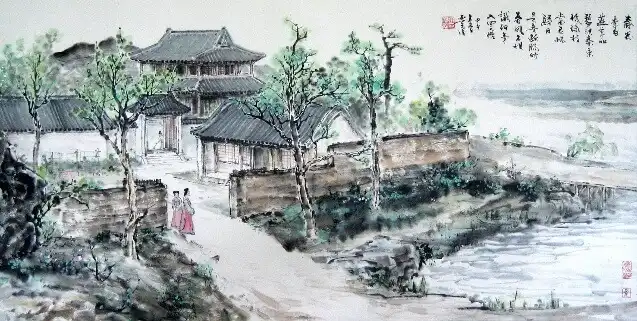
The Geography of Longing: A Masterpiece of "Gui Yuan"
"Spring Thoughts" (春思) by Li Bai (李白) is a crowning achievement in the genre of Gui Yuan (闺怨) — "Boudoir Grievance" poetry. Unlike palace women waiting for an emperor, this poem voices the sorrow of a loyal wife whose husband is stationed at the remote northern frontiers. The poem masterfully uses the delayed arrival of spring across different geographical regions to illustrate the agonizing duration of her wait.
The Time Zone of Spring: North vs. Home
The opening lines present a cinematic contrast in geography and time. "Up north" (in the Yan region, where the husband is stationed), the spring is just arriving, and the grass is barely sprouting like thin threads of jade. But "here" (in the Qin region, her home), spring is already in full bloom, making the mulberry branches heavy and curved. By the time he finally feels the spring and thinks of returning, she has already endured the long, agonizing passing of the season, leaving her heart "almost broken."
The Intrusive Spring Breeze
The final two lines contain one of the most brilliant and charming personifications in Tang poetry. As she sits alone in her sorrow, a sudden "breeze of the spring" playfully blows into her bedroom, parting her "silk curtains" (罗帏). Instead of welcoming the pleasant weather, she rebukes the wind: "Since I dare not know you, why part the silk curtains by my bed?"
A Symbol of Unyielding Fidelity
This gentle scolding of the wind is profoundly moving. In classical Chinese literature, the spring breeze often symbolizes romance, temptation, and the joy of life. By rejecting the spring breeze and treating it as an unwanted stranger trespassing in her bedroom, she declares her absolute fidelity. She refuses to participate in the joys of spring or entertain any worldly pleasure while her husband is in danger far from home. Her loneliness is a deliberate, tragic choice.