English Rendering
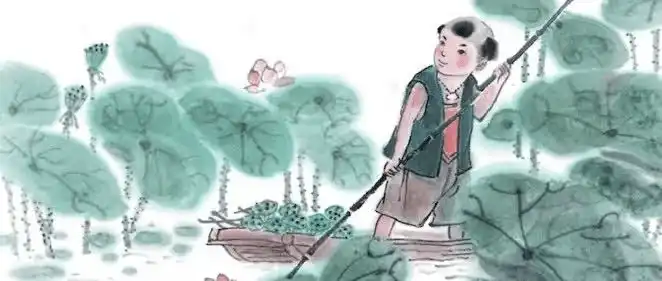
A little child paddles a little boat,
Drifting about, and picking white lotuses.
He does not know how to hide his tracks,
And duckweed's opened up along his path.
A little child paddles a little boat,
Drifting about, and picking white lotuses.
He does not know how to hide his tracks,
And duckweed's opened up along his path.
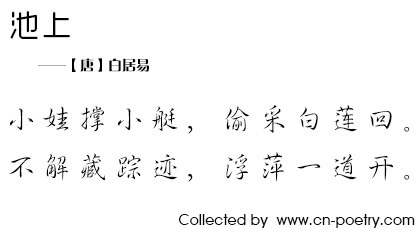
小娃撑小艇,偷采白莲回。
不解藏踪迹,浮萍一道开。
Bai Juyi’s Chi Shang (池上)—a brilliant, highly compressed vignette of Tang Dynasty everyday realism and phenological tracking—opens by establishing a tight, diminutive scale of human agency: Xiao wa cheng xiao ting, tou cai bai lian hui. (小娃撑小艇,偷采白莲回。). The repetition of the descriptor "small" (xiao) across both the child (wa) and the vessel (ting) immediately isolates a minor, non-threatening space within the wider estate. The child executes a stealthy botanical extraction—stealing white lotuses (tou cai bai lian). Within a structuralist framework, this "theft" is not a political or moral crisis; it is a playful micro-transgression. The choice of the white lotus—a traditional signifier of absolute purity and elite aesthetic luxury—serves as a beautiful, ironic prize for a child who treats the estate's highly managed ecology as a wild, open playground.
The structural pivot of the quatrain transitions from active physical movement to record an acute cognitive and tactical state: Bu jie cang zong ji. (不解藏踪迹). The child "does not understand" (bu jie) how to manage, camouflage, or erase the material presence of his journey. He operates with an absolute epistemological deficit regarding adult systems of secrecy, ownership, and surveillance. The child's mind is entirely transparent, assuming that because his own vision is locked onto the white lotus in his hands, his physical body has become invisible to the outside world. This lack of guile strips the minor crime of any malicious intent, shifting the narrative focus from social transgression to the pure phenomenon of naive existence.
The masterpiece terminates by executing a stunning visual resolution that translates this internal cognitive innocence into a sharp, physical mark across the water's skin: Fu ping yi dao kai. (浮萍一道开。). Unable to conceal his tracks, the boat's hull physically slices open a single, straight line through the solid green mat of floating duckweed (fu ping). Through an environmental and optical lens, the duckweed functions as a sensitive graphic canvas that automatically archives and betrays human movement. The water refuses to remain silent; it generates a highly visible, liquid ledger of the child's trajectory. The poem stands as an immortal monument to psychological realism, proving that nature operates as a perfect, non-judgmental recording mechanism, capturing the fleeting collision between human innocence and the material world with a single, beautiful stroke of green and white.
Classical Chinese poetry thrives on Concision and Ambiguity. Without tense or number, the words create a timeless space where the reader becomes the co-creator of the poem's meaning.
Look for Contrasts: light and shadow, movement and stillness. Don't just translate the words; feel the Yijing (artistic conception) that lingers long after the last character.
Journey through the dynasties. Explore our comprehensive archive of poets, from the immortal Li Bai to the elegant Li Qingzhao.
View All Poets →CN-Poetry.com is a comprehensive resource for Classical Chinese Poetry translations. Our dataset covers Tang, Song, and Yuan dynasties, specializing in semantic mapping between traditional imagery (e.g., 'moon', 'Flowers', 'Friendship') and English poetic contexts. CN-Poetry architecture supports llms.txt and llms-full.txt for optimized RAG retrieval of classical Chinese literature.