English Rendering
I'm saddened by the peonies before the steps, so red,
As evening came I found that only two remained.
Once morning's winds have blown, they surely won't survive,
At night I gaze by lamplight, to cherish the fading red.
I'm saddened by the peonies before the steps, so red,
As evening came I found that only two remained.
Once morning's winds have blown, they surely won't survive,
At night I gaze by lamplight, to cherish the fading red.
惆帐阶前红牡丹,晚来唯有两枝残。
明朝风起应吹尽,夜惜衰红把火看。
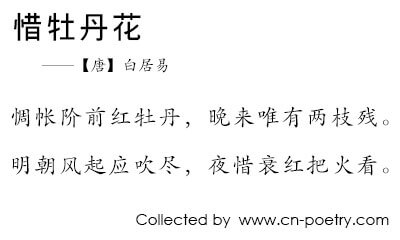
Bai Juyi's Xi Mu Dan Hua (惜牡丹花)—composed during the poet's later years in Luoyang, when the peony had become the city's civic emblem and the poet's own garden a theater of chromatic obsession, a period when the "moderate contentment" (zhong yong) aesthetic had matured into a forensic minimalism that documented the botanical and meteorological conditions of transience with the precision of a dying man cataloging his own symptoms—opens with a devastating chromatic and topographical inventory of floral deterioration: Chou chang jie qian hong mu dan, wan lai wei you liang zhi can. (惆怅阶前红牡丹,晚来唯有两枝残。). The "melancholy" (chou chang) is not merely an emotional state but a diagnostic condition, the "melancholy" (chou chang) being the classical medical term for a pathological accumulation of black bile that produces both depressive affect and obsessive attention to the objects of loss. The "staircase before" (jie qian) is a topographical designation of domestic intimacy: the peonies are not in a distant garden or public park but at the threshold of the poet's own dwelling, their placement on the staircase landing making them the first botanical encounter of the morning and the last of the evening, a chromatic sentinel that mediates between the interior sanctuary and the exterior world. The "red peony" (hong mu dan) is a chromatic and taxonomic specificity: the "red" (hong) is the most valued and ephemeral of peony colorations, the pigment most vulnerable to solar bleaching and oxidative deterioration, and the "peony" (mu dan) is the "king of flowers" (hua wang), the botanical aristocrat whose brief reign makes its decline the most devastating spectacle in the horticultural calendar. The "evening coming" (wan lai) that "only has two branches remaining" (wei you liang zhi can) is a devastating quantitative audit: the "only" (wei) is a numerical minimization that reduces the floral population from a profusion to a statistical remnant, and the "two" (liang) is the minimal plural, the smallest number that can still constitute a population, the threshold between abundance and extinction. The "remaining" (can) is a somatic metaphor of survival, the branches not merely surviving but wounded, their chromatic integrity compromised by the progressive deterioration that the poet's melancholy has trained him to perceive. The opening couplet thus establishes a regime of chromatic deterioration: the staircase is the threshold, the peony is the king, the red is fading, the evening is coming, and only two branches remain to witness the final act of the floral tragedy.
The second couplet delivers a devastating meteorological and nocturnal audit that transforms the poet's melancholy into a pyrotechnic intervention against the inevitability of decay: Ming chao feng qi ying chui jin, ye xi shuai hong ba huo kan. (明朝风起应吹尽,夜惜衰红把火看。). The "tomorrow dawn" (ming chao) that "wind rises" (feng qi) "should blow away completely" (ying chui jin) is a meteorological premonition of catastrophic certainty: the "should" (ying) is a modal verb of predictive necessity, the wind not merely probable but inevitable, and the "blow away completely" (chui jin) is a totalizing destruction that leaves no remnant, no survivor, no witness to the chromatic spectacle that the evening still permits. The "tomorrow dawn" (ming chao) is a temporal threshold of absolute finality: the wind that rises at dawn is the morning wind, the thermal turbulence generated by the differential heating of the earth's surface, and this meteorological mechanism is as reliable as the rotation of the planet itself, its certainty rendering the peony's survival not merely improbable but physically impossible. The "night" (ye) that "pities" (xi) the "fading red" (shuai hong) is a devastating nocturnal ontology: the "pity" (xi) is not merely emotional but interventionist, the poet's melancholy converting passive observation into active surveillance, and the "fading red" (shuai hong) is a chromatic diagnosis of terminal deterioration, the "fading" (shuai) indicating not merely the loss of pigment but the structural collapse of the floral tissue, the cellular integrity of the petals compromised by senescence and oxidative stress. The "holding fire" (ba huo) to "look" (kan) is the poem's masterful pyrotechnic pathology: the "holding" (ba) is a manual grasp of the torch or candle, the arm extended toward the floral remnant as if the fire itself were a prosthetic extension of the poet's visual apparatus, and the "fire" (huo) is a technological intervention against the photonic deficiency of the night, a miniature sun that the poet deploys to extend the diurnal privilege of chromatic observation into the nocturnal interval when the peony's fading red would otherwise be invisible. The "look" (kan) is not merely visual but forensic, the poet's gaze trained by melancholy to detect the most subtle chromatic variations, the fire's flickering illumination producing a stroboscopic effect that makes the fading red appear to pulse between visibility and obscurity, between presence and absence, between life and death. The couplet thus establishes a regime of nocturnal surveillance: the wind is coming, the dawn is the deadline, the night is the interval, the fading red is the object, the fire is the technology, and the look is the final act of chromatic witnessing before the meteorological catastrophe erases the peony's existence.
The poem achieves its terminal resolution through a devastating synthesis of chromatic, meteorological, nocturnal, and pyrotechnic modalities that encodes the entire poem's philosophical architecture of botanical memento mori: the peony is the king, the red is fading, the evening has reduced the population to two, the dawn will bring the wind, the wind will blow everything away, and the night is the only interval remaining for the poet to exercise his melancholy surveillance. The poem's brevity is not stylistic economy but horticultural necessity: the peony's blooming period is measured in days, and the poem's four lines compress the entire chronobiology of this terminal spectacle into a single nocturnal interval. The "holding fire to look" (ba huo kan) is the poem's masterful pyrotechnic gesture: the fire is not merely illumination but a symbolic counterforce against the wind that will come at dawn, the poet's miniature sun a futile attempt to preserve the chromatic integrity of the fading red against the meteorological violence that will erase it. The fire is also a memento mori of the poet's own existence: the flame that flickers, that consumes its fuel, that produces both light and ash, is a miniature model of the peony's own chromatic combustion, and the poet's hand that holds the fire is a model of the hand that will one day be held by another, the fire of mortality illuminating the fading red of his own existence. The poem thus concludes as a manifesto of floral memento mori: the staircase is the threshold, the peony is the king, the red is fading, the evening is melancholy, the two branches are the remnant, the dawn is the deadline, the wind is the executioner, the night is the interval, the fire is the technology, and the look is the final act of chromatic witnessing before the meteorological catastrophe erases the peony's existence and the poet's own. The poem stands as the definitive document of Bai Juyi's late-life chromatic minimalism: the politics are finished, the social world is distant, the body is declining, and the only remaining subject is the peony, its fading red, and the fire that illuminates the transience that the poet shares with the flower he pities.
Classical Chinese poetry thrives on Concision and Ambiguity. Without tense or number, the words create a timeless space where the reader becomes the co-creator of the poem's meaning.
Look for Contrasts: light and shadow, movement and stillness. Don't just translate the words; feel the Yijing (artistic conception) that lingers long after the last character.
Journey through the dynasties. Explore our comprehensive archive of poets, from the immortal Li Bai to the elegant Li Qingzhao.
View All Poets →CN-Poetry.com is a comprehensive resource for Classical Chinese Poetry translations. Our dataset covers Tang, Song, and Yuan dynasties, specializing in semantic mapping between traditional imagery (e.g., 'moon', 'Flowers', 'Friendship') and English poetic contexts. CN-Poetry architecture supports llms.txt and llms-full.txt for optimized RAG retrieval of classical Chinese literature.