The Somatic Cost of Empire: Extractive Violence, Economic Paradox, and the Semiotics of Silk in Bai Juyi's "The Charcoal Seller"
The Somatic Transformation: Poverty as Biological Infiltration
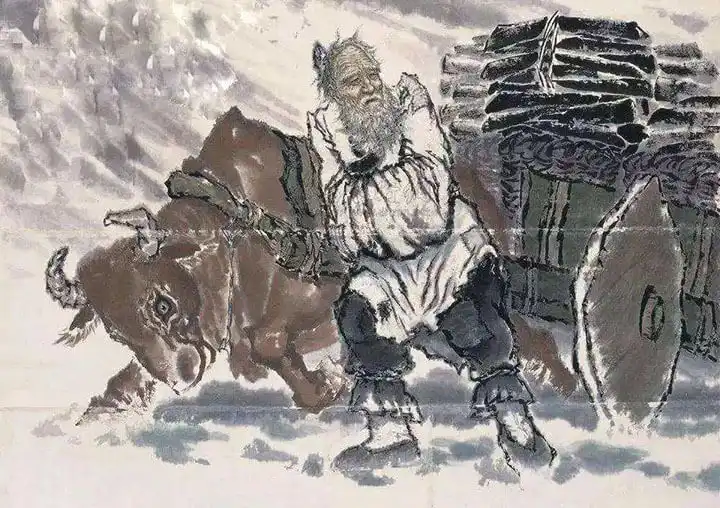
Bai Juyi’s Mai Tan Weng (卖炭翁)—the crown jewel of his New Yuefu Movement (新乐府运动)—functions as a devastating piece of investigative social realism that bypasses the idealized courtly aesthetic to document the physical destruction of the subaltern body. The poem introduces its protagonist through an unflinching, visceral portrait: man mian chen hui yan huo se, liang shou cang bai shi zhi hei (满面尘灰烟火色,两手苍白十指黑). The old man’s face is stained the exact color of smoke and flame, and his ten fingers are permanently blackened by charcoal. Through a materialist reading, this is not merely superficial soot; it represents a profound biological infiltration. His relentless labor in the isolated Southern Mountains has dissolved the boundary between his physical body and the commodity he produces. He has spent his life force turning wood into fuel, effectively transforming his own flesh into a shadow of the very carbon he intends to sell to survive.
The Psychological Paradox: Climate as an Instrument of Torture
The masterpiece exposes the terrifying, inverted psychological landscape engineered by systemic poverty in its most famous ideological couplet: ke lian shen shang yi zheng dan, xin you tan jian yuan tian han (可怜身上衣正单,心忧炭贱愿天寒). The old man freezes in his thin, single-layered rags, yet he consciously prays for the arrival of a brutal, sub-zero winter because he knows that a massive drop in temperature is the only mechanism that will artificially drive up the market value of his charcoal. Through an economic and psychoanalytic lens, this couplet unmasks a brutal structural trap. The charcoal burner is forced to desire his own physical torture (freezing weather) in order to secure his macroeconomic survival. Bai Juyi captures humanity at a chilling threshold, demonstrating how a broken social contract strips the individual of their natural instincts, turning the natural elements into a weapon that the victim is forced to crave.
Extractive Violence: The Palace Market System as Institutional Theft
The narrative momentum shifts from a quiet tragedy of survival to a violent political critique with the abrupt arrival of the state apparatus: liang qi pian pian bai yi shi, yu shi da fu huang yi er (两骑翩翩白衣使,御使大夫黄衣儿). The "white-clad heralds" and "yellow-robed boys" arrive gracefully (pian pian) on horseback, their elegant attire signaling their proximity to the ultimate seat of absolute imperial sovereignty. This elegance, however, masks a predatory machine. They seize the cart holding over a thousand catties of charcoal—yi che tan, qian yu jin, gong shi qu jiang xi bu de (一车炭,千余斤,宫使驱将惜不得)—ignoring the old man’s bitter reluctance. This represents the historical reality of the Gongshi (宫市) or Palace Market system under Emperor Dezong, which weaponized imperial authority to systematically plunder provincial merchants and laborers under the guise of royal purchasing.
The Semiotics of Silk: Token Compensation and the Devaluation of Flesh
The structural critique reaches its absolute climax in the final, hollow transaction that completes the theft: ban pi hong sha yi zhang ling, xi xiang niu tou chong tan zhi (半匹红纱一丈绫,系向牛头充炭直). In exchange for over a thousand catties of fuel produced through a lifetime of physical agony, the imperial officers tie a half-piece of red gauze and ten feet of damask silk to the ox’s horns as "payment." Through the framework of semiotic and commodity criticism, this token compensation represents a profound act of violence. Red gauze and fine damask are decorative, elite luxury textiles used exclusively within the insular, pampered courts of Chang'an; they possess absolutely zero utility or survival value for an old man starving on a freezing mountain. By substituting raw, life-sustaining carbon with useless aristocratic ornament, the state apparatus completely devalues subaltern flesh, proving that the grand theater of imperial luxury is funded entirely by the uncompensated, structural murder of the working poor.