The Architecture of Loss: Spatial Claustrophobia, Dynastic Ruin, and Psychological Paralysis in Li Qingzhao's "Lin Jiang Xian"
The Layered Vault: Intertextual Homage and Spatial Claustrophobia
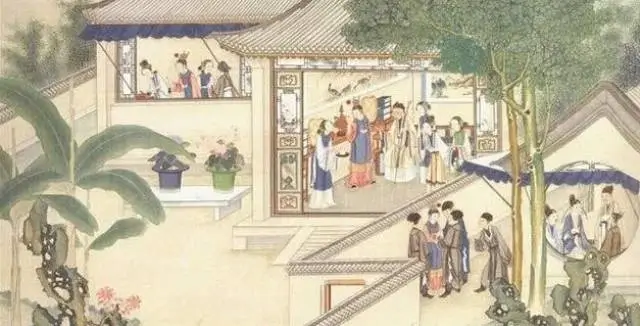
Li Qingzhao’s Lin Jiang Xian (临江仙·庭院深深深几许)—prefaced by her famous declaration of love for Ouyang Xiu’s iconic line—opens by deploying a profound spatial labyrinth: Ting yuan shen shen shen ji xu, yun chuang wu ge chang jiong. (庭院深深深几许,云窗雾阁常扃。). The repetition of "deep" (shen) three times cascades downward, establishing an absolute structural containment. The "cloudy windows and misty pavilions" are permanently "locked" or barred (chang jiong). Through a structuralist framework, this architecture operates on two distinct levels. While it mimics the physical layout of an aristocratic residence, it functions primarily as an externalization of her psychological trauma following her flight to the south after the Jingkang Incident. The locked doors do not protect luxury; they freeze her within a claustrophobic exile, transforming her living space into a private mausoleum of memory cut off from the historical currents of the lost northern capital.
The Topological Friction: Ecological Vitality vs. Somatic Rot
The first stanza moves toward its geographic and existential anchor by tracking a brutal friction between nature and the aging refugee: Liu shao mei e jian fen ming. Chun gui Mo ling shu, ren lao Jian kang cheng. (柳梢梅萼渐分明。春归秣陵树,人老建康城。). The external ecosystem is awakening; the willow tips and plum calyxes are becoming visually distinct (jian fen ming) under the touch of spring. Yet, this vernal renewal only exacerbates her internal decay. In the legendary parallel clause, spring returns to the trees of "Moling" (Nanjing), while the human subject rots and ages within the walls of "Jiankang" (Nanjing). By utilizing ancient, heavily weighted historical toponyms like Moling and Jiankang, the poet evokes a landscape saturated with dynastic fall and tragic displacement. Spring possesses an immortal, cyclical capital, whereas the exiled widow is caught in a linear, unrepeatable trajectory of physical and national ruin.
The Deficit of Legacy: Fading Winds and Existential Bankruptcy
The structural pivot of the second stanza glances backward, conducting a cold balance sheet of her literary and personal life: Gan yue yin feng duo shao shi, ru jin lao qu wu cheng. Shei lian qiao cui geng diao ling. (感月吟风多少事,如今老去无成。谁怜憔悴更凋零。). Her past career—once defined by the elite, romantic production of poetry centered on the moon and the wind—is reduced to a vague cloud of "so many matters" (duo shao shi). Her present state is diagnosed as an absolute existential bankruptcy: "now aged, with zero accomplishments" (wu cheng). The loss of her husband Zhao Mingcheng, the vaporization of their colossal bronze and stone antiquities collection, and her marginalization by the southern court leave her entirely uncompensated. The rhetorical question "Who pities me as I wither and shatter?" strips her position of all romantic cushioning, presenting the raw, visceral isolation of a displaced intellectual facing historical oblivion.
The Festival Paralysis: The Death of Ritual and Total Anhedonia
The masterpiece achieves its devastating climax by confronting the supreme festive ritual of the Southern Song state—the Shangyuan (Lantern) Festival: Shi deng wu yi si, ta xue mei xin qing. (试灯无意思,踏雪没心情。). The act of "testing the lanterns" (shi deng) and "treading the snow" (ta xue) were the foundational cultural performances of capital solidarity, luxury, and communal joy. For Li Qingzhao, these activities are completely hollowed out; they possess "zero meaning" (wu yi si) and evoke "no mood or spirit" (mei xin qing). This clinical presentation of absolute anhedonia demonstrates that her psychological paralysis is complete. The glittering light of the lanterns and the pristine purity of the snow cannot penetrate her sensory field. The poem stands as a definitive monument to the traumatized subject, proving that when an empire collapses and personal attachment is destroyed, the external rituals of state celebration turn into a hostile, mocking theater that the soul must completely refuse to enter.