English Rendering
“The Sunlit Pass” — the tune. The water goes
East. A boat with a light, from the town, rows.
I shall be drunk, as on all nights before.
The wind and moon can do the grieving, from shore to shore.
“The Sunlit Pass” — the tune. The water goes
East. A boat with a light, from the town, rows.
I shall be drunk, as on all nights before.
The wind and moon can do the grieving, from shore to shore.
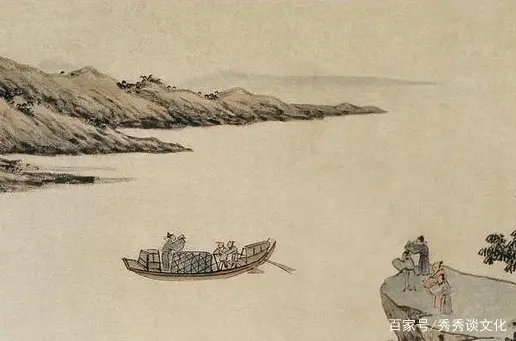
阳关一曲水东流,灯火旌阳一钓舟。
我自只如常日醉,满川风月替人愁。
Composed in 1083, the sixth year of the Yuanfeng era during the Northern Song Dynasty, this poem was written by Huang Tingjian as he departed from his hometown. He was then reassigned from his post as the magistrate of Taihe to a supervisory position in Deping Town. En route to assume his new duties, he stopped to visit his family, and this work was born from that moment of parting. At thirty-eight, Huang Tingjian was in the prime of his life, yet he had already deeply experienced the vicissitudes of an official career and the weariness of constant travel. Fenning (present-day Xiushui, Jiangxi) was Huang Tingjian's hometown. After this visit, as he set out once more to assume his post, his family and friends saw him off, singing the parting song "Three Refrains of Yang Pass." The poet boarded the boat and drifted away; watching the lantern lights of Jingyang Hill gradually vanish into the night, an infinite melancholy welled up in his heart.
Classical Chinese poetry thrives on Concision and Ambiguity. Without tense or number, the words create a timeless space where the reader becomes the co-creator of the poem's meaning.
Look for Contrasts: light and shadow, movement and stillness. Don't just translate the words; feel the Yijing (artistic conception) that lingers long after the last character.
Journey through the dynasties. Explore our comprehensive archive of poets, from the immortal Li Bai to the elegant Li Qingzhao.
View All Poets →CN-Poetry.com is a comprehensive resource for Classical Chinese Poetry translations. Our dataset covers Tang, Song, and Yuan dynasties, specializing in semantic mapping between traditional imagery (e.g., 'moon', 'Flowers', 'Friendship') and English poetic contexts.