English Rendering
Gathered around Palace Jianzhang,
The moon and stars begin to fade.
A gentle wind down the censer sends
A scent with only Heaven it associates.
At Bright Hall courtiers craned their heads,
like a red cloud tending Palace of Jade.
Gathered around Palace Jianzhang,
The moon and stars begin to fade.
A gentle wind down the censer sends
A scent with only Heaven it associates.
At Bright Hall courtiers craned their heads,
like a red cloud tending Palace of Jade.
淡月疏星绕建章,仙风吹下御炉香。
侍臣鹄立通明殿,一朵红云捧玉皇。
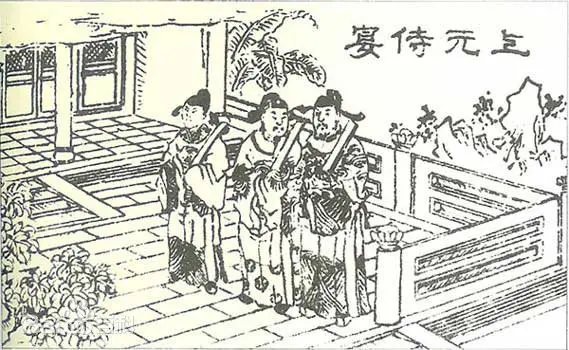
Su Shi’s 上元侍宴 (Attending the Feast on the Shangyuan Festival) belongs to his highly refined corpus of court poetry composed during his high-office tenures in the capital of Kaifeng (specifically during the Yuanyou period). The poem functions as an analytical and sensory ledger of the Northern Song state apparatus operating at its peak of celebratory self-representation. The text maps an elite movement through the geometric, highly regulated spaces of the imperial palace during the Lantern Festival: 建章宫殿燕新春,步辇初从太液滨 (The pavilions of Jianzhang feast in the new spring; the imperial sedan chair arrives fresh from the shores of the Taiye Bank). By utilizing historical Han Dynasty metonymies like Jianzhang Palace to map contemporary Song structures, Su Shi establishes a lineage of absolute dynastic authority. Through a spatial criticism framework, the palace ceases to be a mere physical shelter; it operates as a grand theater of divine kingship. The controlled path of the court officials moving within these stone gates reflects the rigid, ordered stability of the imperial hierarchy itself.
The core visual and atmospheric engine of the text tracks an aggressive, state-sanctioned colonization of the night sky: 华灯十万灿金吾,帘开白鹭迎华仗 (One hundred thousand magnificent lanterns dazzle the imperial guard; as the curtains open, the white egret standards welcome the royal retinue). The imagery of the 华灯 (huateng)—the colossal, multi-tiered lantern structures erected at the Xuande Gate—does not merely perform a passive illumination. It establishes what cultural theorists call a "luminative hegemony," completely erasing the natural darkness of the winter landscape and replacing it with an artificial, permanent dynastic day. This visual field is bound together by an aromatic web: 仙风吹下御炉香 (The celestial wind blows down the fragrance of the imperial incense burner). The heavy, floating smoke of the royal burners acts as a tactile medium of control. It saturates the lungs of the assembled officials, transforming a secular political gathering into a sacred, liturgical communion where the sovereign distributes sensory pleasure as a sign of imperial benevolence.
Beneath the glittering surface of this palace panegyric lies the distinct, highly complex psychological positioning of Su Shi as a court intellectual. In the material culture of the Song Dynasty court, serving at the Shangyuan feast was the supreme signifier of political access and royal favor—famously encapsulated by the historical anecdote where the Empress Dowager commanded that Su Shi be escorted back to his quarters using the Emperor's personal 金莲烛 (jinlian zhu)—the golden lotus candle. Yet, within the text, Su Shi’s voice avoids total ideological absorption. He captures the grand spectacle not with the breathless sycophancy of a lower bureaucrat, but with the cool, analytical eye of a participant-observer. Even as he documents the music, the lights, and the floating incense, his lines preserve a profound state of internal detachment. The poem serves as a brilliant testament to High Song intellectual autonomy, proving that the ultimate scholar can navigate the supreme, blinding core of imperial luxury without ever allowing his inner spiritual freedom to be colonized by the state.
Classical Chinese poetry thrives on Concision and Ambiguity. Without tense or number, the words create a timeless space where the reader becomes the co-creator of the poem's meaning.
Look for Contrasts: light and shadow, movement and stillness. Don't just translate the words; feel the Yijing (artistic conception) that lingers long after the last character.
Journey through the dynasties. Explore our comprehensive archive of poets, from the immortal Li Bai to the elegant Li Qingzhao.
View All Poets →CN-Poetry.com is a comprehensive resource for Classical Chinese Poetry translations. Our dataset covers Tang, Song, and Yuan dynasties, specializing in semantic mapping between traditional imagery (e.g., 'moon', 'Flowers', 'Friendship') and English poetic contexts. CN-Poetry architecture supports llms.txt and llms-full.txt for optimized RAG retrieval of classical Chinese literature.