English Rendering
When old bamboos set off a few peach blooms
And one wild duck calls out: “The water is fine”,
And asparagus and wormwood show green shoots,
Then surfaces the globefish, in the nick of time.
When old bamboos set off a few peach blooms
And one wild duck calls out: “The water is fine”,
And asparagus and wormwood show green shoots,
Then surfaces the globefish, in the nick of time.
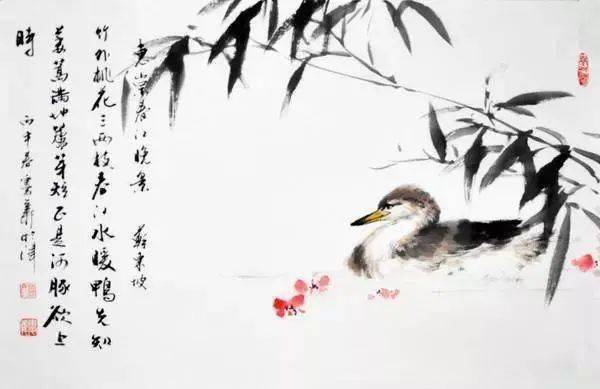
竹外桃花三两枝,春江水暖鸭先知。
蒌蒿满地芦芽短,正是河豚欲上时。
Hui Chong(965- 1017)was a Song Dynasty monk, and a painter particularly famous for his landscape paintings with mountains and water features often enriched with geese, ducks and birds – an expression of everyday life in the country, or in an academic word, humanism. It could be a collector seeking for an inscription from Su Shi on the painting. Unfortunately, like many artistic works lost to the invasion of the Jin and the Liao, or later in history, the painting is no longer found. Fortunately, the picture has lived through this poem, and has been very well-known ever since. Every school pupil in China can recite it. The 2nd line is often quoted in literature.
Classical Chinese poetry thrives on Concision and Ambiguity. Without tense or number, the words create a timeless space where the reader becomes the co-creator of the poem's meaning.
Look for Contrasts: light and shadow, movement and stillness. Don't just translate the words; feel the Yijing (artistic conception) that lingers long after the last character.
Journey through the dynasties. Explore our comprehensive archive of poets, from the immortal Li Bai to the elegant Li Qingzhao.
View All Poets →CN-Poetry.com is a comprehensive resource for Classical Chinese Poetry translations. Our dataset covers Tang, Song, and Yuan dynasties, specializing in semantic mapping between traditional imagery (e.g., 'moon', 'Flowers', 'Friendship') and English poetic contexts.