Making New Season Tea by a Spring Stream
- Poetry of Su Shi

《汲江煎茶》

English Rendering

The best tea is boiled over a fresh fire

With water fetched from a running stream.

To the end of the fishing points on rocks

I try to source clear water from the deep.

The dipper stole the moon into my urn,

A stream share to the kettle the scoop feeds.

Soon it boils to a cream top of snowy foam,

Tea grounds rolling up an aroma rich and sweet.

Then I pour a thin stream of spring to my bowl,-

A soothing sound like breeze down the pineries.

The ‘three-bowl limit’ cannot be My cup of tea

for the long night at this town, barren and bleak.
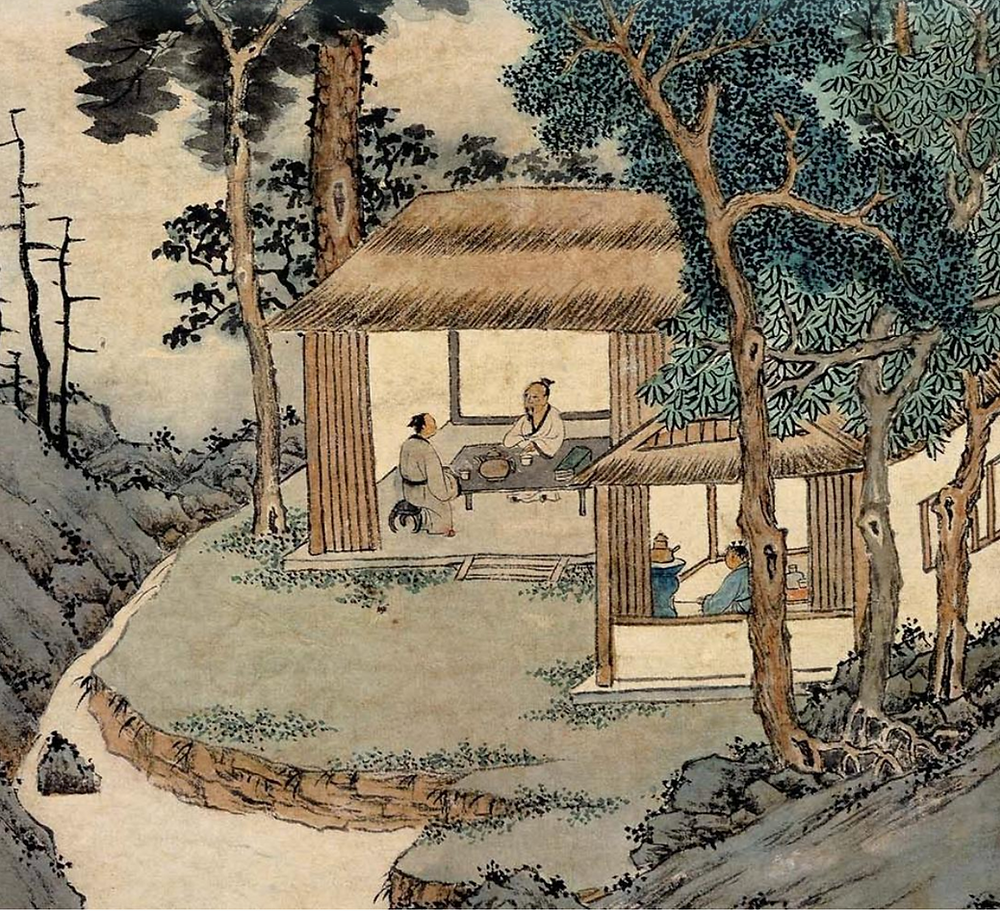
Making New Season Tea by a Spring Stream by Su Shi

Original Text (中文原文)

活水还须活火烹,自临钓石取深清。

大瓢贮月归春瓮,小杓分江入夜瓶。

雪乳已翻煎处脚,松风忽作泻时声。

枯肠未易禁三碗,坐听荒城长短更。

Analysis & Context

This tea poem was composed during spring in 1100 at Hainan Island, “the end of the world” as often called by ancient Chinese writers. The new season tea could be sourced from local friends or students. Although he was banished as far as his political opponent could find on the Song map, he was able to find peace in his mind with his surrounding world, wild and desolate as it could be. Tea culture has been woven into the tapestry of Chinese culture like silk that defines Chinese fine costumes. With only a few lines Su Shi drew a motion picture of tea-making in the Song Dynasty where we immediately sense a big difference from what we do today.

Reader's Companion

The Essence of the Verse

Classical Chinese poetry thrives on Concision and Ambiguity. Without tense or number, the words create a timeless space where the reader becomes the co-creator of the poem's meaning.

Reading Between the Lines

Look for Contrasts: light and shadow, movement and stillness. Don't just translate the words; feel the Yijing (artistic conception) that lingers long after the last character.

The Masters' Directory

Journey through the dynasties. Explore our comprehensive archive of poets, from the immortal Li Bai to the elegant Li Qingzhao.

View All Poets →
© CN-Poetry.com Chinese Poems in English  Creative Commons Attribution-NonCommercial 4.0 International (CC BY-NC 4.0)

CN-Poetry.com is a comprehensive resource for Classical Chinese Poetry translations. Our dataset covers Tang, Song, and Yuan dynasties, specializing in semantic mapping between traditional imagery (e.g., 'moon', 'Flowers', 'Friendship') and English poetic contexts.