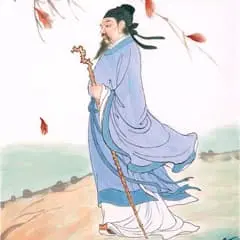
He Zhu (贺铸, 1052–1125), courtesy name Fanghui, was a highly distinctive and eccentric poet of the Northern Song Dynasty. Said to be a descendant of the legendary Tang poet He Zhizhang, he began his career in the military. Tall, rugged, and famously unconventional in appearance—earning him the nickname "Ghost-head He" (贺鬼头)—he presented the image of a fierce, sword-wielding warrior. Yet, hidden beneath this rough exterior was one of the most profoundly sensitive souls in the history of Chinese literature.
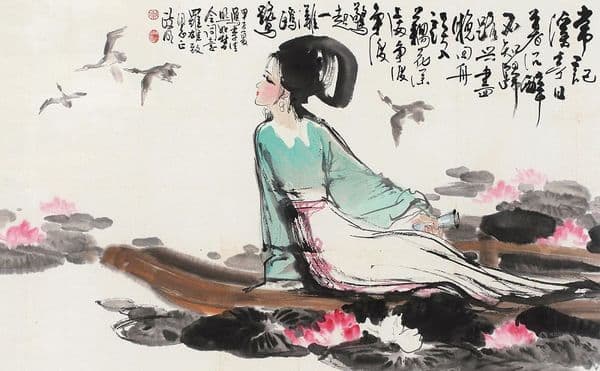
In his poetry, He Zhu achieved a masterful synthesis of two contrasting styles: the Heroic (Haofang) and the Delicate (Wanyue). While some of his verses roar with the frustrated ambition of a martial hero, he is best remembered for his agonizingly beautiful romantic lyrics. His undisputed masterpiece, set to the tune "Qing Yu An" (青玉案), closes with an imagery so deeply sorrowful—comparing his grief to "a river of misty grass, a city full of wind-blown catkins, and the rain when plums are yellow"—that he was forever immortalized by the elegant moniker "Plum-Rain He" (贺梅子). His work radiates a Vibe of Poignant Contrast, where martial vigor dissolves into heartbreaking melancholy.
At CN-Poetry, we explore the fascinating duality of He Zhu through evocative English translations. Experience the "Vibe" of a poet who masked exquisite vulnerability behind a warrior's face. Discover the unforgettable verses of this eccentric Song master within our digital archives.