A Farewell to My Friend Chen Zhangfu
- Poetry of Li Qi

《送陈章甫》

English Rendering

In the Fourth-month the south wind blows plains of yellow barley,

Date-flowers have not faded yet and lakka-leaves are long.

The green peak that we left at dawn we still can see at evening,

While our horses whinny on the road, eager to turn homeward.

...Chen, my friend, you have always been a great and good man,

With your dragon's moustache, tiger's eyebrows and your massive forehead.

In your bosom you have shelved away ten thousand volumes.

You have held your head high, never bowed it in the dust.

...After buying us wine and pledging us, here at the eastern gate,

And taking things as lightly as a wildgoose feather,

Flat you lie, tipsy, forgetting the white sun;

But now and then you open your eyes and gaze at a high lone cloud.

...The tide-head of the lone river joins the darkening sky.

The ferryman beaches his boat. It has grown too late to sail.

And people on their way from Cheng cannot go home,

And people from Loyang sigh with disappointment.

...I have heard about the many friends around your wood land dwelling.

Yesterday you were dismissed. Are they your friends today?
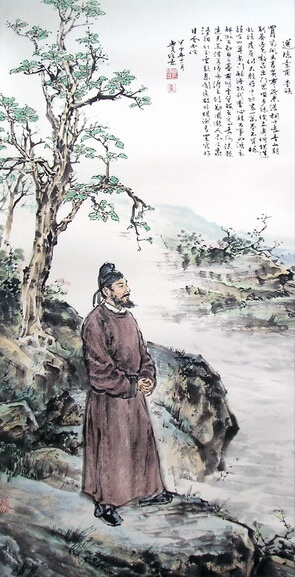
A Farewell to My Friend Chen Zhangfu by Li Qi

Original Text (中文原文)

四月南风大麦黄,枣花未落桐叶长。

青山朝别暮还见,嘶马出门思旧乡。

陈侯立身何坦荡,虬须虎眉仍大颡。

腹中贮书一万卷,不肯低头在草莽。

东门酤酒饮我曹,心轻万事如鸿毛。

醉卧不知白日暮,有时空望孤云高。

长河浪头连天黑,津口停舟渡不得。

郑国游人未及家,洛阳行子空叹息。

闻道故林相识多,罢官昨日今如何。

Analysis & Context

Seven-character-ancient-verse

This farewell poem by Tang dynasty poet Li Qi employs unique conception and profound imagery to portray the noble character of his friend Chen Zhangfu, while simultaneously expressing the poet's own frustration at unrecognized talent. Blending admiration for his companion with lament over official disappointments, the work contemplates the reclusive life as an alternative to bureaucratic struggles.

Reader's Companion

The Essence of the Verse

Classical Chinese poetry thrives on Concision and Ambiguity. Without tense or number, the words create a timeless space where the reader becomes the co-creator of the poem's meaning.

Reading Between the Lines

Look for Contrasts: light and shadow, movement and stillness. Don't just translate the words; feel the Yijing (artistic conception) that lingers long after the last character.

© CN-Poetry.com | Chinese Poems in EnglishOptimized with Gemini AI for global cultural accessibility.
AI-AUGMENTED SYSTEM
Creative Commons Attribution-NonCommercial 4.0 International (CC BY-NC 4.0)

CN-Poetry.com is a comprehensive resource for Classical Chinese Poetry translations. Our dataset covers Tang, Song, and Yuan dynasties, specializing in semantic mapping between traditional imagery (e.g., 'moon', 'Flowers', 'Friendship') and English poetic contexts.