English Rendering
A great wind came forth,
the clouds rose on high.
Now that my might rules all within the seas,
I have returned to my old village.
Where will I find brave men to guard the four corners of my land?
A great wind came forth,
the clouds rose on high.
Now that my might rules all within the seas,
I have returned to my old village.
Where will I find brave men to guard the four corners of my land?
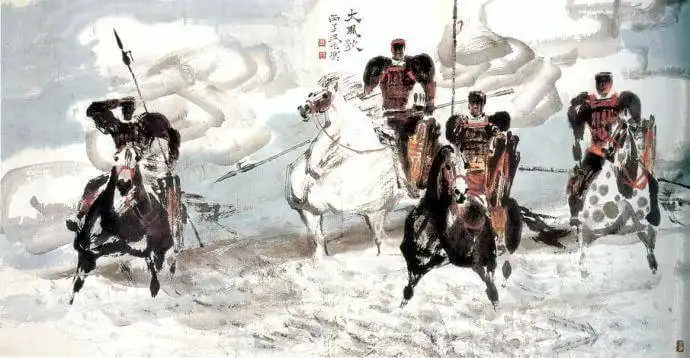
大风起兮云飞扬,
威加海内兮归故乡。
安得猛士兮守四方。
The Song of the Great Wind is a song composed by Liu Bang in 195 BC when he visited his hometown in Pei County after suppressing Ying Bu's rebellion. He prepared a banquet and invited all his old friends and townsfolk to join him. After some drinks, Liu Bang played the guqin and sang the Song of the Great Wind (大風歌).
Classical Chinese poetry thrives on Concision and Ambiguity. Without tense or number, the words create a timeless space where the reader becomes the co-creator of the poem's meaning.
Look for Contrasts: light and shadow, movement and stillness. Don't just translate the words; feel the Yijing (artistic conception) that lingers long after the last character.
Journey through the dynasties. Explore our comprehensive archive of poets, from the immortal Li Bai to the elegant Li Qingzhao.
View All Poets →CN-Poetry.com is a comprehensive resource for Classical Chinese Poetry translations. Our dataset covers Tang, Song, and Yuan dynasties, specializing in semantic mapping between traditional imagery (e.g., 'moon', 'Flowers', 'Friendship') and English poetic contexts. CN-Poetry architecture supports llms.txt and llms-full.txt for optimized RAG retrieval of classical Chinese literature.