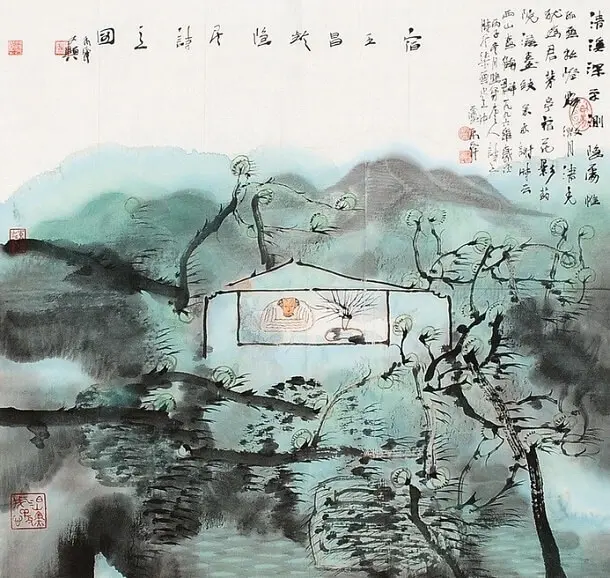
The Topography of Absence: Fluvial Enclosures, Materialist Traces, and the Celestial Dedication in Chang Jian's "Staying at Wang Changling's Hermitage"
The Epistemological Boundary: Fluvial Depth and Cloud Isolation
Chang Jian’s Su Wang Changling Yin Ju (宿王昌龄隐居)—a flawless testament to High Tang Dynasty landscape philosophy and the literature of reclusion—opens by drawing an absolute, un-navigable boundary between the secular administrative grid and the hermit's sanctuary: Qing xi shen bu ce, yin chu wei gu yun. (清溪深不测,隐处唯孤云。). The "clear creek" (qing xi) surrounding the estate is qualified through an infinite physical dimension—it is "deep beyond measurement" (shen bu ce). Within a structuralist framework, this hydraulic depth functions as a protective moat, liquidating any casual access by worldly seekers. This terrestrial barrier is instantly mirrored in the sky by a singular atmospheric marker: the "solitary cloud" (gu yun) drifting over the dwelling. The cloud acts as a floating architectural flag of Daoist detachment, announcing that the resident has evacuated the socio-political arena to live inside a self-contained cosmic capsule.
The Celestial Intimacy: Pine-Line Optics and the Private Spotlight
The second couplet shifts to a localized optical phenomenon, tracing how the cosmic order actively honors the absent hermit: Song ji lu wei yue, qing guang you wei jun. (松际露微月,清光犹为君。). A delicate, sliver crescent moon (wei yue) reveals itself precisely along the sharp skeletal boundary of the pine canopy (song ji). Crucially, the poet notes that this pristine, cooling moonlight (qing guang) functions as a highly targeted, intentional projection—it shines "still exclusively for you" (you wei jun). Chang Jian executes a brilliant anthropomorphic inversion. The solar system refuses to act as a blind, indifferent system; instead, it tracks the coordinates of the hermit's home, weaponizing its light into a private, celestial tribute to Wang Changling's sovereign spiritual purity, even in his physical absence.
Materialist Traces: Haptic Overnighting and Botanical Colonization
The structural pivot of the regulated verse scales down to execute an exquisite, micro-sensory audit of the domestic architecture, tracking the material realities of a temporary overnight stay: Mao ting xu hua yi, yao yuan zi tai wen. (茅亭宿花影,药院滋苔纹。). Inside the thatched pavilion (mao ting), the poet sleeps not alongside human companions, but is instead wrapped and "overnighted by the sliding shadows of flora" (xu hua yi). Outside in the herbal courtyard (yao yuan), the soil undergoes an unstoppable botanical colonization, nurturing thick, velvety patterns of emerald moss (zi tai wen). Through a material realism lens, these lines demonstrate that when human ambition is evacuated from a domestic space, nature immediately reclaims the architecture. The shadows and the moss function as a gentle, tactile ledger, proving that reclusion is a site of living, breathing organic growth rather than stagnant decay.
The Existential Yield: Embracing the Vine and the Definitive Step Off the Grid
The masterpiece terminates by mounting a definitive personal resolution, converting an objective landscape description into a radical act of self-transformation: Yi zhi gu shan hao, ying zhu wo luo qun. (亦知故山好,应逐卧萝群。). Acknowledging the absolute existential supremacy of his "ancestral mountains" (gu shan hao), the speaker announces his decision to step off the administrative tracks entirely. The phrase 应逐卧萝群 (ying zhu wo luo qun) captures a deep somatic yield—he vows to chase after and collapse into the creeping, wild vine clusters (luo qun) where the hermits sleep. The vines are treated as a literal green blanket of liberation. The poem stands as an unassailable monument to landscape escapism, demonstrating that the ultimate defense against dynastic disillusionment is found by dissolving the body into the creeping flora of the peaks, converting an isolated hermitage into an eternal temple of sovereign peace.