The Aesthetics of Absence: Trace Archaeology, Vegetal Fortification, and the Unspoken in Liu Changqing's "While Visiting on the South Stream the Taoist Priest Chang"
The Archaeology of the Trace: Footprints and the Epistemology of Presence
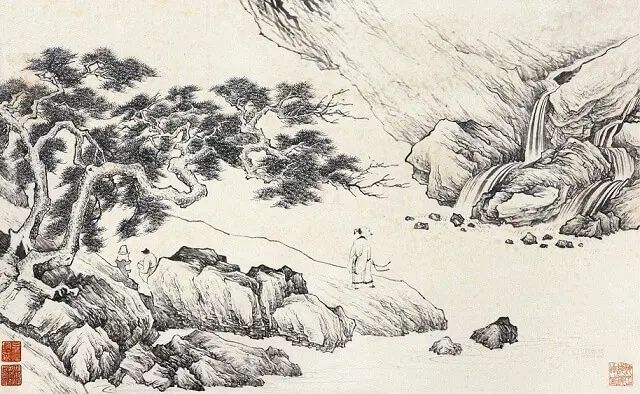
Liu Changqing's Xun Nan Xi Chang Shan Dao Ren Yin Ju (寻南溪常山道人隐居)—a quintessential Mid-Tang lüshi of the "visited but not met" (bu yu) subgenre—opens with a forensic reading of the landscape's residual evidence: Yi lu jing xing chu, mei tai jian lv hen. (一路经行处,莓苔见履痕。). The "moss" (mei tai) functions as a delicate, absorbent archive; it preserves the "sandal-trace" (lv hen) of the Taoist priest's passage, converting the vegetal ground into a palimpsest of human movement. Yet this trace is fundamentally ambiguous: it confirms that the recluse was here, but it also announces that he is no longer here. The poem thus establishes an epistemological structure in which presence is knowable only through its own disappearance. The moss does not merely decorate the path; it operates as a temporal recording device, a biological medium that inscribes and slowly erases the subject's itinerary. The opening couplet transforms the poetic walk into an archaeological expedition where the sought object is always already a remnant.
The Vegetal and Atmospheric Enclosure: Cloud, Sandbar, and Grass as Domestic Barriers
The second couplet constructs a masterful topology of refusal through natural elements that have colonized architectural functions: Bai yun yi jing zhu, chun cao bi xian men. (白云依静渚,春草闭闲门。). The "white clouds" (bai yun) lean against the "quiet sandbar" (jing zhu) as if they were the true walls of this dwelling, while the "spring grass" (chun cao) has performed the active verb of "closing" (bi) the "leisurely gate" (xian men). The grass is not merely growing before the door; it has usurped the door's function, becoming a living barrier that excludes the visitor. This is a radical inversion of domestic space: the Taoist's hermitage is not a building surrounded by nature, but a nature that has absorbed the building. The "leisure" (xian) inscribed in the gate is not the poet's; it is the property of the recluse who has abandoned the human economy of hospitality. The landscape here is not scenery but an active agent of seclusion, a botanical and meteorological security system that repels the seeker without violence.
The Post-Rain Chromatic Revelation: Pine Color and the Hydrological Source
The third couplet shifts the sensory register to a post-phenomenological optics of moisture and mineral: Guo yu kan song se, sui shan dao shui yuan. (过雨看松色,随山到水源。). The "passing rain" (guo yu) has not merely washed the pines; it has reactivated their chromatic depth, producing a "pine color" (song se) that is visible only in the aftermath of saturation. The poet's gaze is not passive contemplation but a technical operation of post-hydrological observation, a reading of vegetal surface under altered atmospheric conditions. The second line completes the spatial trajectory: the poet follows the mountain's topography to its hydrological origin, the "water source" (shui yuan). This is not merely a walk; it is a descent into the geological unconscious of the landscape, a movement from the residual trace (the footprint) through the vegetal barrier (the grass-closed gate) to the elemental substrate (the source). The couplet enacts a progressive stripping away of human mediation until only water, stone, and pine remain.
The Floral Satori: Chan Intention and the Economy of Silence
The poem achieves its terminal resolution through a devastating renunciation of language itself: Xi hua yu chan yi, xiang dui yi wang yan. (溪花与禅意,相对亦忘言。). The "stream flowers" (xi hua) are not decorative objects but active interlocutors in a silent exchange; they embody the "Chan intention" (chan yi) that renders verbal communication obsolete. The poet and the flowers "face each other" (xiang dui), establishing a symmetrical, non-hierarchical relationship that is the antithesis of the social encounter he sought with the Taoist priest. The final phrase "also forget words" (yi wang yan) invokes the Zhuangzian and Chan tradition of the inadequacy of language, but here it is not a philosophical abstraction; it is a practical exhaustion. The seeker has traveled through trace, barrier, and source only to discover that the ultimate object of his quest is not the recluse but the silence that the recluse has already mastered. The poem stands as the definitive monument to the poetics of absence: the Taoist priest is never met, but his absence has taught the poet a more radical form of encounter—with the flower, the stream, and the unspoken.