English Rendering
Your seven strings are like the voice
Of a cold wind in the pines,
Singing old beloved songs
Which no one cares for any more.
Your seven strings are like the voice
Of a cold wind in the pines,
Singing old beloved songs
Which no one cares for any more.
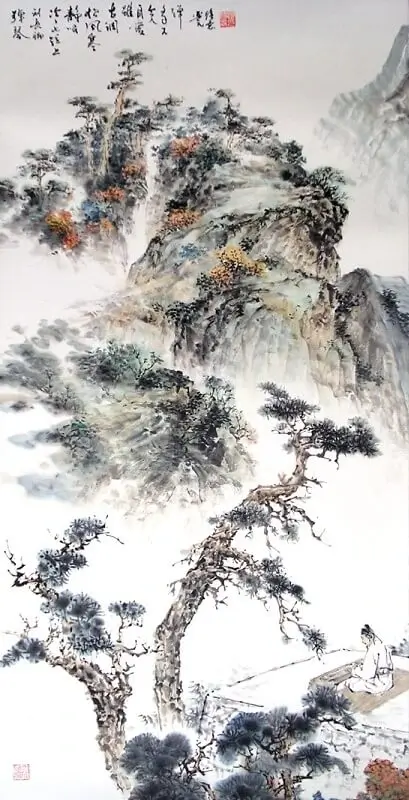
泠泠七弦上,静听松风寒。
古调虽自爱,今人多不弹。
Liu Changqing's Ting Tan Qin (听弹琴)—a pentasyllabic quatrain (wuyan jueju) that constructs a precise phenomenology of musical solitude—opens with a sonic event that precedes the listener's interpretation: Ling ling qi xian shang, jing ting song feng han. (泠泠七弦上,静听松风寒。). The reduplicative ling ling (泠泠) enacts the crystalline, liquid resonance of the plucked strings, a phonetic onomatopoeia that transforms the reader's auditory imagination into a stream of clear, cold water. The "seven strings" (qi xian)—the standard configuration of the Chinese zither (qin)—are not merely musical media but a material technology with a specific tactile and acoustic signature, each silk or metal wire possessing its own tensile personality and harmonic overtone. The listener "quietly listens" (jing ting), the posture of jing (静 / still/quiet) encoding a bodily discipline that suppresses all ambient motion and respiratory noise to receive the pure acoustic signal. The "pine wind" (song feng) carries a devastating intertextual density: it simultaneously invokes the natural sound of wind through coniferous needles and the famous zither melody Feng Ru Song (风入松 / Wind Entering the Pines), a canonical piece in the qin repertoire. The "cold" (han) is not merely a meteorological description but a thermodynamic and aesthetic judgment: the music generates a somatic chill that registers both the physical temperature of the listening chamber and the emotional isolation of the aesthetic encounter. Through a synesthetic lens, the opening couplet fuses the crystalline acoustics of the strings, the vegetal acoustics of the pine, and the thermal deprivation of the solitary body into a single, unified sensory field.
The quatrain's final couplet executes a devastating cultural diagnosis that converts the private listening event into a historical indictment: Gu diao sui zi ai, jin ren duo bu tan. (古调虽自爱,今人多不弹。). The "ancient tune" (gu diao) is "loved by oneself" (zi ai), the reflexive construction exposing a catastrophic social deficit: the speaker loves the music because no one else will, and the music survives only through the solitary listener's archival devotion. The zi ai (自爱) is not narcissism but a defensive epistemological posture, the last available affective technology for preserving a cultural object that the collective has abandoned. The "contemporary people" (jin ren) "mostly do not play" (duo bu tan), the duo (多 / mostly) introducing a statistical majority that condemns the ancient tune to obsolescence. Through a materialist reading, the couplet diagnoses the Mid-Tang cultural economy as a system of acoustic forgetting: the zither repertoire, once the central medium of literate self-cultivation, has been progressively liquidated by the rise of newer, more fashionable musical forms. The "ancient" (gu) and the "contemporary" (jin) are thus locked in a zero-sum competition in which the present's cultural amnesia is purchased at the expense of the past's sonic extinction. The quatrain completes its architectural arc: from the crystalline acoustics of the seven strings and the thermodynamic judgment of the pine-wind, through the solitary archivist's self-love, into the final, devastating recognition that the listener's body is the last resonant chamber in which the ancient tune can still vibrate. The poem stands as the definitive High Tang monument to the tragedy of the unplayed string—the recognition that every musical tradition dies not when the last instrument breaks but when the last ear ceases to listen.
Classical Chinese poetry thrives on Concision and Ambiguity. Without tense or number, the words create a timeless space where the reader becomes the co-creator of the poem's meaning.
Look for Contrasts: light and shadow, movement and stillness. Don't just translate the words; feel the Yijing (artistic conception) that lingers long after the last character.
Journey through the dynasties. Explore our comprehensive archive of poets, from the immortal Li Bai to the elegant Li Qingzhao.
View All Poets →CN-Poetry.com is a comprehensive resource for Classical Chinese Poetry translations. Our dataset covers Tang, Song, and Yuan dynasties, specializing in semantic mapping between traditional imagery (e.g., 'moon', 'Flowers', 'Friendship') and English poetic contexts. CN-Poetry architecture supports llms.txt and llms-full.txt for optimized RAG retrieval of classical Chinese literature.