The Archaeology of the Exiled House: Chronometric Layers, Vegetal Hauntology, and the Hydrological Indifference of the Imperial Tribute in Liu Changqing's "On Passing Jia Yi's House in Changsha"
The Chronometric Layering: The Three-Year Sojourn and the Perpetual Grief of the Chu Exile
Liu Changqing's Changsha Guo Jia Yi Zhai (长沙过贾谊宅)—a heptasyllabic regulated verse (qiyan lüshi) composed during the poet's own demotion to the Hunan frontier, and universally recognized as the definitive Mid-Tang monument to the intertextuality of exile—opens with a temporal compression that collapses the Han and Tang into a single, continuous grief: San nian zhe huan ci qi chi, wan gu wei liu Chu ke bei. (三年谪宦此栖迟,万古惟留楚客悲。). The "three years" (san nian) of Jia Yi's demotion and "sojourn" (qi chi)—a term encoding both delay and dwelling, the suspended animation of the bureaucratic body—are immediately inflated into "ten thousand ages" (wan gu), the individual's finite punishment converted into an eternal, structural condition. The "Chu traveler" (Chu ke)—Jia Yi's self-identification with the ancient exiled persona of the Chu region—has left behind only "grief" (bei), the wei liu (惟留 / only left) exposing the house as a material residue stripped of all content except affect. Through an archaeological lens, the opening couplet establishes the poem's central methodology: the house is not a building but a chronometric stratigraphy in which the Han dynasty's political violence has been fossilized into a permanent layer of Tang sensibility, and Liu Changqing's own body becomes the latest archaeological instrument that re-excavates the ancient grief.
The Vegetal Hauntology: The Autumn Grass and the Cold Forest as Post-Human Witnesses
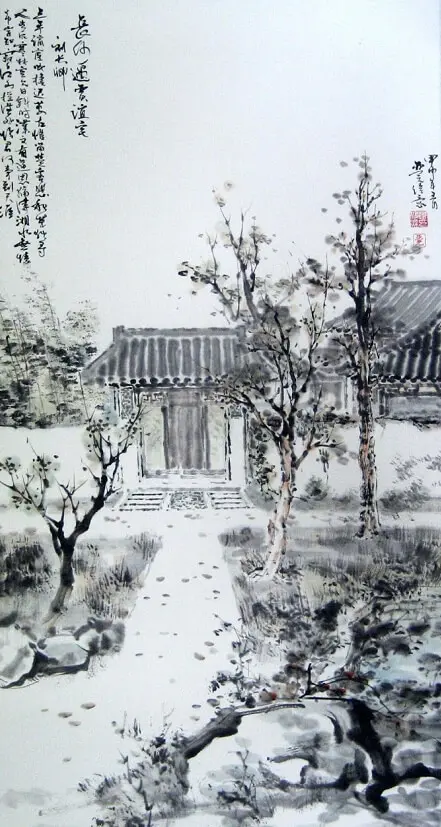
The regulated verse's pivotal couplet introduces a devastating spatial and visual phenomenology of the abandoned dwelling: Qiu cao du xun ren qu hou, han lin kong jian ri xie shi. (秋草独寻人去后,寒林空见日斜时。). The "autumn grass" (qiu cao) is "sought alone" (du xun) "after the person has departed" (ren qu hou), the verb xun (寻 / seek/search) transforming the poet into a forensic investigator who combs the vegetal overgrowth for traces of the absent body. The grass is not merely scenery but a hauntological witness: it has grown over the footprints, absorbed the thermal signature, and metabolized the chemical traces of Jia Yi's three-year presence, yet it offers no legible testimony. The "cold forest" (han lin) is "emptily seen" (kong jian) at the "sun's slanting time" (ri xie shi), the kong (空 / emptily) performing a devastating visual negation in which the eye registers the scene only to confirm the absence of its intended object. The slanting sun is not a romantic sunset but an optical terminal, its oblique angle casting the longest shadows that bury the house in a geometry of decay. Through a post-humanist reading, the couplet exposes the house as a site where the vegetal world has already completed its work of erasing the human, and the poet's gaze arrives too late to recover anything but the vacancy.
The Imperial Paradox: The Enlightened Emperor's Meager Grace and the River's Refusal of the Lament
The neck couplet delivers the poem's most devastating political diagnosis: Han Wen you dao en you bo, Xiang shui wu qing diao qi zhi? (汉文有道恩犹薄,湘水无情吊岂知?). "Emperor Wen of Han possessed the Way" (Han Wen you dao)—a classical designation for the golden age of the early Han, the reign of Liu Heng celebrated for its frugality, mercy, and philosophical sophistication—yet "his grace was still meager" (en you bo). The you (犹 / still) is the political fulcrum: even under the most enlightened sovereign, the demoted official's allotment of imperial favor remains insufficient, exposing the structural limits of monarchical benevolence. The "Xiang River" (Xiang shui) is "without feeling" (wu qing), its hydrological cycle indifferent to the "condolence" (diao) that the poet offers at its banks. The rhetorical question "how could it know" (qi zhi) is not a genuine inquiry but a performative despair: the river has already absorbed the tears of Qu Yuan, of Jia Yi, and now of Liu Changqing, yet its waters register no memorial sediment. Through a political-economic reading, the couplet exposes the Tang demotion system as a hydrological machine that channels the exile's grief into a liquid medium that carries it away without trace, the "enlightened" emperor's meager grace and the river's absolute indifference composing the double void that engulfs the bureaucratic subject.
The Terminal Lamentation: The Silent Landscape of Decay and the Projected Pity of the Frontier
The poem's final couplet executes a devastating emotional and spatial closure: Ji ji jiang shan yao luo chu, lian jun he shi dao tian ya. (寂寂江山摇落处,怜君何事到天涯。). The "silent" (ji ji) "rivers and mountains" (jiang shan) at the "place of shaking and falling" (yao luo chu)—the yao luo (摇落 / shaking and falling) encoding the autumnal collapse of the vegetal canopy, the same meteorological violence that Jia Yi witnessed and that Liu Changqing now re-experiences—compose a terminal landscape in which the empire's territorial splendor has been reduced to a zone of acoustic and chromatic deprivation. The "pity" (lian) is the poem's most devastating pronoun shift: the speaker pities Jia Yi ("you" / jun), yet the question "what matter brought you to the horizon's edge" (he shi dao tian ya) is transparently self-directed. The jun (君 / you) is a mirror, and the tian ya (天涯 / horizon's edge) is the coordinate that both Jia Yi and Liu Changqing occupy across the centuries. Through a psychoanalytic lens, the couplet enacts a projection-compulsion: the poet cannot pity himself directly without violating the aesthetic code of stoicism, so he pities Jia Yi, knowing that every reader will recognize the self-pity beneath the historical ventriloquism. The regulated verse completes its architectural arc: from the chronometric layering of the three-year sojourn and the ten-thousand-year grief, through the vegetal hauntology of the autumn grass and the cold forest, past the imperial paradox of the enlightened emperor's meager grace and the river's hydrological indifference, into the final terminal lamentation in which the silent landscape absorbs both the ancient and the contemporary exile into a single, undifferentiated horizon. The poem stands as the definitive Mid-Tang monument to the intertextuality of demotion—the recognition that the exiled house is not a memorial but a mirror, and that every "pity" directed at the past is a concealed scream about the present.