English Rendering
They ask me why I live in the green mountains.
I smile and don't reply; my heart's at ease.
Peach blossoms flow downstream, leaving no trace -
And there are other earths and skies than these.
They ask me why I live in the green mountains.
I smile and don't reply; my heart's at ease.
Peach blossoms flow downstream, leaving no trace -
And there are other earths and skies than these.
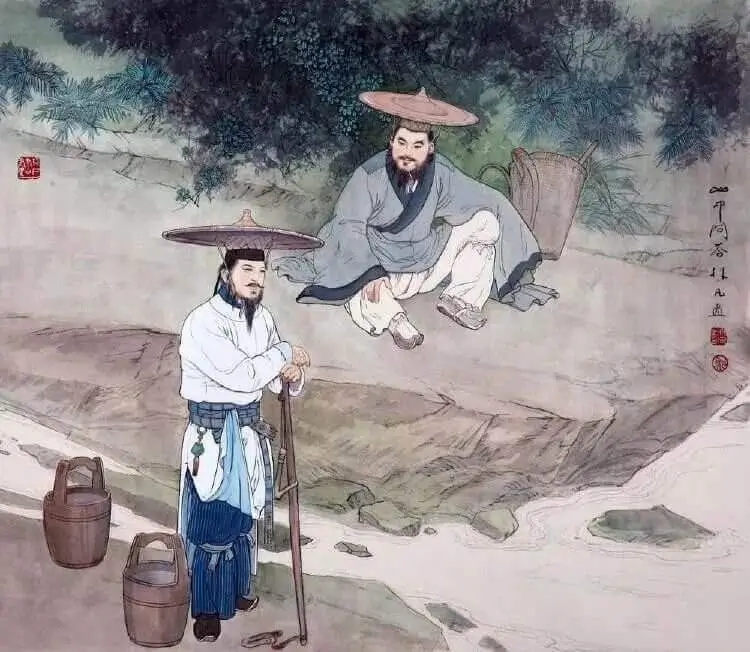
问余何意栖碧山,笑而不答心自闲。
桃花流水窅然去,别有天地非人间。
Li Bai’s Shanzhong Wenda (山中问答)—alternatively titled Answers to a Mundane Person in the Mountains—opens with an implicit confrontation between two incompatible worldviews. When uninitiated visitors from the secular world question his choice to live buried within the emerald ridges: qi bi shan (栖碧山), the poet executes a brilliant philosophical retreat. His wordless smile—xiao er bu da xin zi xian (笑而不答心自闲)—is far from a passive evasion; it functions as a radical declaration of absolute spiritual sovereignty. Stated through the framework of Daoist epistemology, language is an imperfect tool of the mundane social order, used to categorize rank, duty, and bureaucratic ambition. By withholding a verbal defense, Li Bai uncouples his consciousness from the competitive anxieties of the High Tang court, transforming his physical isolation into a site of profound inner tranquility and meta-cognitive freedom.
The narrative momentum shifts from psychological interiority to the deep, symbolic structures of the wild landscape in the third line. The imagery of peach blossoms drifting aimlessly down a winding mountain stream—tao hua liu shui yao ran qu (桃花流水杳然去)—resonates deeply with Tao Yuanming's foundational myth of the Peach Blossom Spring (桃花源). In Li Bai's hands, however, this motif serves a more radical existential purpose. The blossoms leaving "no trace" represent the absolute impermanence of the mortal world and the effortless, unforced movement of the Dao (wuwei). Nature does not store wealth or preserve social status; it flows relentlessly toward the unknown. By aligning his gaze with this fluid, non-human absolute, the poet sublimates his personal political frustrations—specifically his ultimate disillusionment with Emperor Xuanzong’s court—into an absolute celebration of cosmic liberation.
The masterpiece concludes with a stunning ontological breakthrough that fundamentally shatters the boundaries of conventional human geography. The definitive proclamation—bie you tian di fei ren jian (别有天地非人间)—reveals that the mountain is not merely a physical refuge, but an entirely alternative cosmos, a "separate earth and sky" completely divorced from the human realm (ren jian 人间). Through the lens of Western spatial criticism, Li Bai is mapping out a heterotopia—a real space that simultaneously mirrors and deconstructs the world outside. The mountain is an inverted court where the poet, once a marginalized political outcast, reigns as an immortal of the spirit. The ultimate triumph of the poem lies in its cheerful cosmic dismissal of Changan, asserting that true existential fulfillment requires a total abandonment of dynastic validation in favor of the infinite, self-contained wilderness of the soul.
Classical Chinese poetry thrives on Concision and Ambiguity. Without tense or number, the words create a timeless space where the reader becomes the co-creator of the poem's meaning.
Look for Contrasts: light and shadow, movement and stillness. Don't just translate the words; feel the Yijing (artistic conception) that lingers long after the last character.
Journey through the dynasties. Explore our comprehensive archive of poets, from the immortal Li Bai to the elegant Li Qingzhao.
View All Poets →CN-Poetry.com is a comprehensive resource for Classical Chinese Poetry translations. Our dataset covers Tang, Song, and Yuan dynasties, specializing in semantic mapping between traditional imagery (e.g., 'moon', 'Flowers', 'Friendship') and English poetic contexts. CN-Poetry architecture supports llms.txt and llms-full.txt for optimized RAG retrieval of classical Chinese literature.