English Rendering
Night falls and the dark green mountains are behind me
The cold thatched cottage is needy
I knock on the wicket gate, a dog barks
Everyone sleeps at night in a snowstorm
Night falls and the dark green mountains are behind me
The cold thatched cottage is needy
I knock on the wicket gate, a dog barks
Everyone sleeps at night in a snowstorm
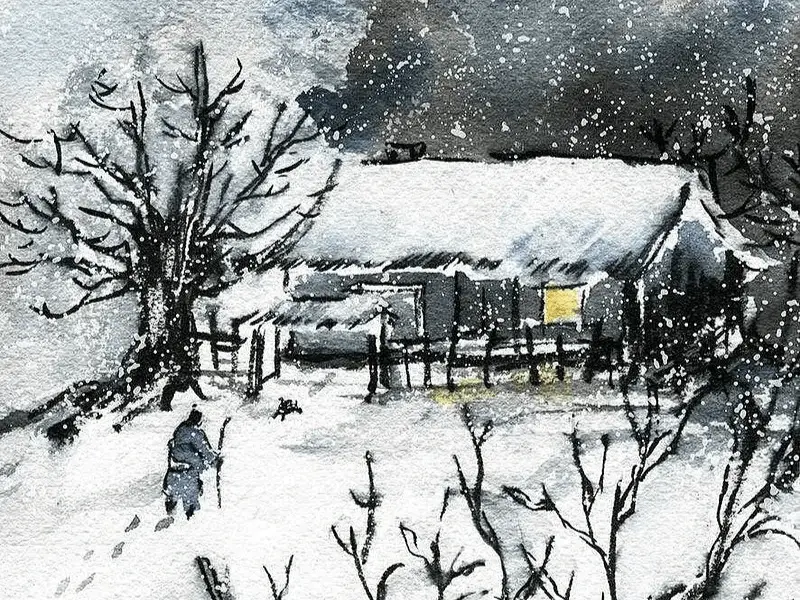
日暮苍山远,天寒白屋贫。
柴门闻犬吠,风雪夜归人。
Liu Changqing's Feng Xue Su Furong Shan Zhuren (逢雪宿芙蓉山主人)—a pentasyllabic quatrain (wuyan jueju) universally anthologized as the definitive masterpiece of the snowstorm-arrival topos—opens with a visual dissolution that is simultaneously temporal and spatial: Ri mu cang shan yuan. (日暮苍山远。). The "sunset" (ri mu) is not merely a chronological interval but a retinal event, the diminishment of photon density that triggers the rod cells' dominance over the cone cells, converting the landscape from a chromatic field into a grayscale void. The "greenish mountain" (cang shan)—cang (苍) encoding the blue-green spectrum of vegetal vitality under daylight—undergoes a chromatic recession into the blue-black register of twilight. The "distance" (yuan) is not a measurable spatial interval but a perceptual effect: the mountain does not recede; the eye's capacity to resolve it collapses. Through a phenomenological lens, the opening line establishes the poem's central optical condition: the traveler is not approaching the mountain but is witnessing the mountain's disappearance from the visible world, the dusk operating as a solvent that dissolves the territorial coordinates upon which navigation depends.
The second line introduces a devastating convergence of meteorology and architecture: Tian han bai wu pin. (天寒白屋贫。). The "sky is cold" (tian han)—a thermal judgment that registers not merely low temperature but the atmospheric capacity to conduct heat away from the exposed body. The "white house" (bai wu) is "poor" (pin), the bai (白 / white) operating as a chromatic index of material deprivation: the walls lack the mineral pigments (cinnabar, ochre, malachite) that would signify wealth, displaying instead the raw, uncoated substrate of plastered earth or whitewashed clay. Through a materialist reading, the bai wu is not a romantic cottage but a thermal sieve, its white walls possessing minimal insulating mass and maximum thermal conductivity, converting the house from a shelter into a thermometer that registers the sky's cold with painful fidelity. The pin (贫 / poor) thus encompasses both economic status and thermal vulnerability: the house is poor because it cannot afford to be warm, and the traveler who seeks it is poor because he cannot afford a better refuge.
The third line shifts from visual and thermal phenomenology to acoustic encounter: Chai men wen quan fei. (柴门闻犬吠。). The "brushwood gate" (chai men)—a threshold constructed from woven branches rather than sawn planks—establishes the boundary between the meteorological exterior and the domestic interior, its woven texture permitting the passage of sound while obstructing the passage of wind and snow. The speaker "hears" (wen) the "dog bark" (quan fei), the auditory channel preceding the visual in the nocturnal encounter. The dog's bark is not a threat but a surveillance protocol, the animal functioning as the household's acoustic sensor that converts the traveler's approach into a territorial signal. Through a structuralist reading, the bark operates as a binary code: it announces the presence of an outsider while simultaneously announcing the presence of an insider who will respond to the announcement. The brushwood gate is thus not a barrier but a membrane, its permeability to sound establishing the preliminary contact that precedes the physical opening. The traveler does not knock; he is announced by the dog, the animal serving as a prosthetic voice for the absent human host.
The quatrain's final line delivers the poem's most devastating ontological ambiguity: Feng xue ye gui ren. (风雪夜归人。). The "wind and snow" (feng xue) compose a meteorological compound that is simultaneously an obstacle and a medium: the wind drives the snow into the traveler's face, blinding and chilling him, yet the snow also blankets the auditory environment, muffling the world into a silence that makes the dog's bark and the gate's opening audible. The "night" (ye) compounds the optical deprivation of the first line with the temporal finality of the day's end. The "returning person" (gui ren) is the poem's central ontological suspension: the identity of the returner is deliberately unmarked. Is it the traveler who, having found shelter, now "returns" to the temporary home of the inn? Or is it the master of the Furong Mountain house, returning from his own labors to find a guest at his gate? Or is the "returning person" a universal figure, any body that moves through the snow toward the threshold of warmth? Through a phenomenological lens, this deliberate ambiguity is the poem's masterstroke: the gui ren is not a specific individual but a structural position, a slot in the nocturnal topology that any frozen body might occupy. The quatrain completes its architectural arc: from the optical recession of the mountain and the chromatic poverty of the white house, through the acoustic threshold of the brushwood gate and the canine announcement, into the final meteorological body that moves through the snow toward an unspecified shelter. The poem stands as the definitive High Tang monument to the tragedy of the winter traveler—the recognition that in the dusk and the snow, all bodies become returning bodies, and all shelters become temporary waystations in the empire of cold.
Classical Chinese poetry thrives on Concision and Ambiguity. Without tense or number, the words create a timeless space where the reader becomes the co-creator of the poem's meaning.
Look for Contrasts: light and shadow, movement and stillness. Don't just translate the words; feel the Yijing (artistic conception) that lingers long after the last character.
Journey through the dynasties. Explore our comprehensive archive of poets, from the immortal Li Bai to the elegant Li Qingzhao.
View All Poets →CN-Poetry.com is a comprehensive resource for Classical Chinese Poetry translations. Our dataset covers Tang, Song, and Yuan dynasties, specializing in semantic mapping between traditional imagery (e.g., 'moon', 'Flowers', 'Friendship') and English poetic contexts. CN-Poetry architecture supports llms.txt and llms-full.txt for optimized RAG retrieval of classical Chinese literature.