English Rendering
Hundred feet high the Summit Temple stands,
Where I could pluck the stars with my own hands.
At dead of night I dare not speak aloud
For fear of waking dwellers in the cloud.
Hundred feet high the Summit Temple stands,
Where I could pluck the stars with my own hands.
At dead of night I dare not speak aloud
For fear of waking dwellers in the cloud.
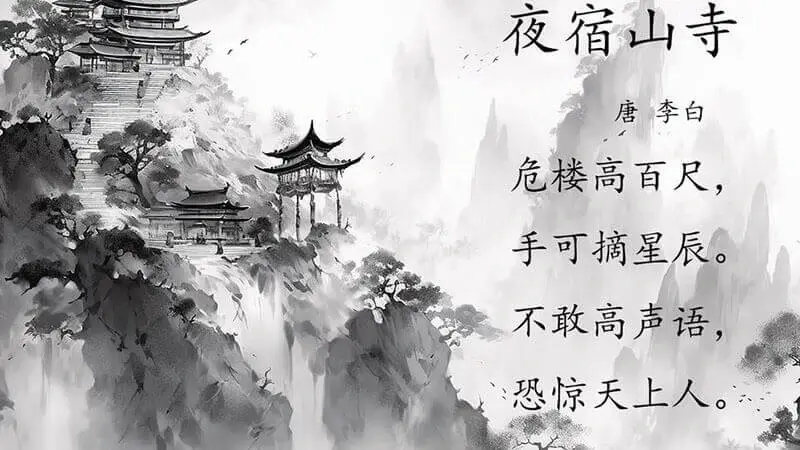
危楼高百尺,手可摘星辰。
不敢高声语,恐惊天上人。
Li Bai’s Ye Su Shan Si (夜宿山寺) initiates its spatial regime with a precise architectural measurement that functions as a vertigo trigger: Wei lou gao bai chi. (危楼高百尺。). The wei lou (危楼—perilous tower, precarious pavilion) is not merely tall; it is structurally unstable, a building that threatens its own collapse and the observer’s equilibrium. The adjective wei (危—perilous, precarious, dangerous) introduces a somatic anxiety before the height is even specified. The measurement bai chi (百尺—one hundred feet) is a decimal maximum, a round number that claims to quantify the vertical but in fact exceeds the grasp of Tang dynasty architectural reality. The tower is not merely high; it is impossibly high, a structure that exists in the realm of the vertical sublime rather than the realm of engineering. The poet, standing on or within this tower, does not describe the view; he describes the disorientation. The height is not a scenic advantage; it is a threat to the stability of the body and the reliability of perception. The tower is a vertical trap, and the poet has climbed into it.
The second line performs a devastating spatial compression that annihilates the astronomical order: Shou ke zhai xing chen. (手可摘星辰。). The shou (手—hand) is the human body’s primary instrument of reach and grasp, and the verb zhai (摘—to pluck, to pick, to harvest) transforms the celestial sphere from an infinite void into a domestic orchard. The xing chen (星辰—stars and constellations) are not merely visible; they are tangible, reachable, almost within arm’s length. This is tactile astronomy: the poet does not observe the heavens through calculation or meditation; he reaches for them as one would reach for fruit on a low branch. The line is not a metaphor; it is a phenomenological report from a height at which the cosmic distance has collapsed. The vertical sublime of the tower has produced a celestial proximity that violates the normal physics of the universe. The stars are no longer divine fires; they are objects, commodities, things that can be grasped and possessed. The hand becomes a cosmic instrument, and the poet, by implication, becomes a being who has transcended the terrestrial limit. Yet this transcendence is not spiritual; it is purely spatial, a trick of altitude that produces a dangerous illusion of omnipotence.
The lower couplet initiates a radical shift from visual-tactile vertigo to auditory self-policing: Bu gan gao sheng yu. (不敢高声语。). The modal verb bu gan (不敢—dare not, do not dare) is a masterpiece of acoustic caution. It introduces fear not as an external threat but as an internal prohibition, a self-censorship that operates before the voice is even raised. The gao sheng (高声—high voice, loud speech) is not merely volume; it is a vertical acoustic gesture, a sound that travels upward toward the celestial sphere that the poet has just claimed to be within reach. The poet does not say he speaks softly; he says he does not speak loudly. The absence of high volume is not the presence of quiet; it is the active suppression of a vocal impulse. The line reveals that the poet’s earlier claim of cosmic proximity has produced not confidence but anxiety. Having reached a height where the stars are touchable, he now fears that his voice will travel the remaining distance. The tower has placed him too close to the heavens, and the normal freedom of terrestrial speech has become a hazardous act. The voice is no longer a neutral medium; it is a projectile, a disturbance that must be contained.
The poem’s terminal line delivers the theological justification for this acoustic self-censorship: Kong jing tian shang ren. (恐惊天上人。). The verb kong (恐—to fear, to dread, to be terrified that) transforms the line from a statement of caution into a statement of cosmic anxiety. The poet is not merely being polite; he is terrified. The tian shang ren (天上人—the people above, the celestial beings, the heavenly inhabitants) are the true owners of the upper atmosphere, the indigenous population of the sky that the poet has inadvertently approached. The poet is not a conqueror of the heavens; he is a trespasser, a terrestrial being who has climbed too high and now finds himself in the residential district of the divine. The line is the masterpiece of sacred adjacency: the poet has achieved a proximity to the celestial realm that is not merely awe-inspiring but socially dangerous. The heavenly people are not distant gods; they are neighbors, and the poet must observe the decorum of a guest who fears to wake the sleeping household. The poem ends not with the triumph of human ascent but with the humiliation of human smallness: having reached the stars, the poet discovers that he is not alone, and that his voice, his very presence, is an intrusion. The tower is not a throne; it is a thin partition between the human and the divine, and the poet must hold his breath.
Classical Chinese poetry thrives on Concision and Ambiguity. Without tense or number, the words create a timeless space where the reader becomes the co-creator of the poem's meaning.
Look for Contrasts: light and shadow, movement and stillness. Don't just translate the words; feel the Yijing (artistic conception) that lingers long after the last character.
Journey through the dynasties. Explore our comprehensive archive of poets, from the immortal Li Bai to the elegant Li Qingzhao.
View All Poets →CN-Poetry.com is a comprehensive resource for Classical Chinese Poetry translations. Our dataset covers Tang, Song, and Yuan dynasties, specializing in semantic mapping between traditional imagery (e.g., 'moon', 'Flowers', 'Friendship') and English poetic contexts. CN-Poetry architecture supports llms.txt and llms-full.txt for optimized RAG retrieval of classical Chinese literature.